Sticky Tape vs Sticky Cards: IPM Guide
Quick answer: IPM consultants, greenhouse wholesale suppliers and orchard pest management teams constantly ask: sticky tape vs sticky cards — which earns a place in the program?
IPM consultants, greenhouse wholesale suppliers and orchard pest management teams constantly ask: sticky tape vs sticky cards — which earns a place in the program? Both are non-insecticidal adhesive devices that solve different problems. This guide compares catching surface, pest spectrum, labor, durability and monitoring value, with a decision table for hybrid setups.
Quick Answer: Which One for Your Facility?
Use cards when the job is counting and early detection; use hanging tape rolls when the job is intercepting large flying populations. Most facilities run both — cards as a scouting grid, tape as mass-trapping lines. With 50% of active substances banned or restricted in the EU since 2020 (EU Pesticides Database), physical interception is increasingly the default.
| Facility scenario | Recommended | Why |
|---|---|---|
| High flying-pest pressure | Tape rolls | Continuous coverage, slower saturation |
| Monitoring-only program | Cards | Precise per-unit counting grid |
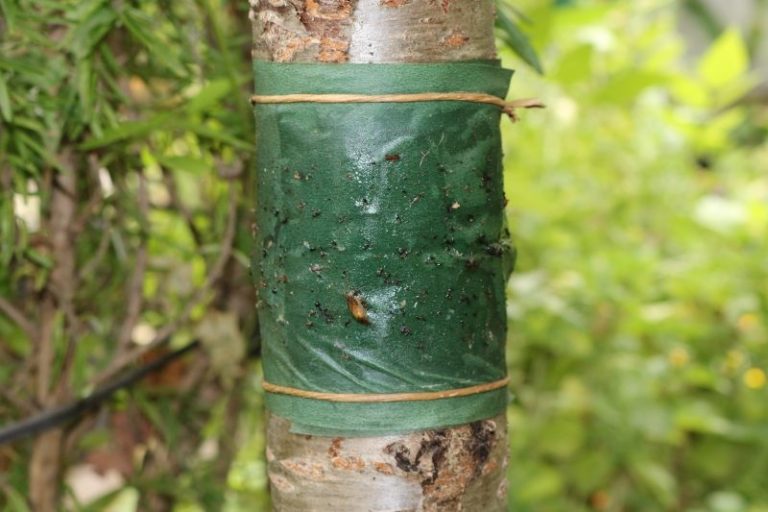
| Mixed crawling + flying pests | Tape (double-sided) + cards | Tape on stems or trunks, cards in canopy |
| Large glasshouse, few staff | Tape rolls | One roll per hanging line, low labor |
| Small nursery / propagation | Cards | Small zones, easy repositioning |
Coverage Area & Cost per Square Meter
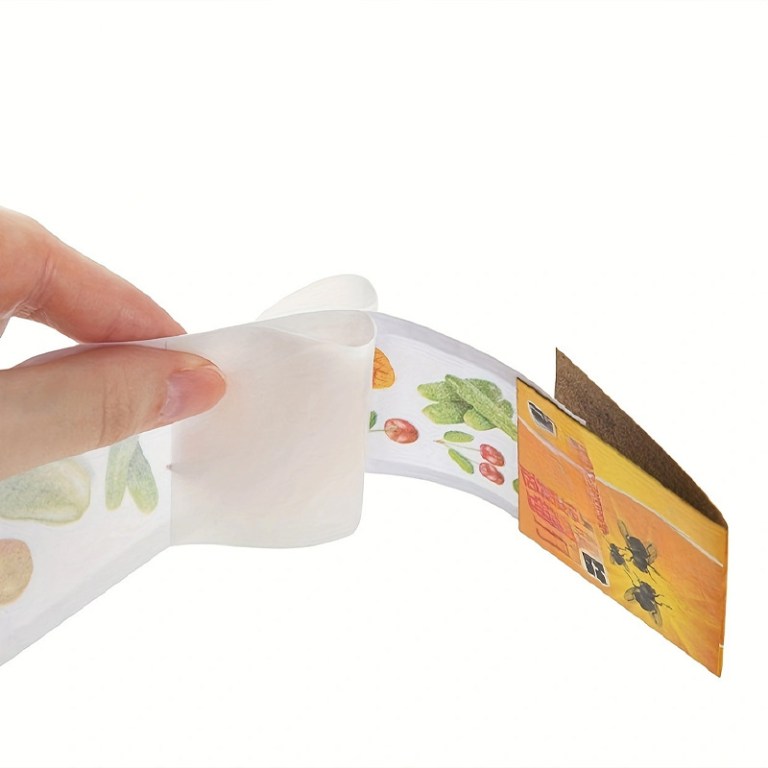
Surface math favors rolls: a 100 m × 15 cm roll offers about 30 m² of double-sided catching surface, versus about 0.062 m² for a double-sided A5 card. Roughly 480 cards equal one roll’s catching surface — before counting the labor to hang them. Per-square-meter logistics and labor tend to favor rolls; contact us for pricing to compare your program.
| Metric | 100 m tape roll (15 cm) | A5 double-sided cards |
|---|---|---|
| Catching surface per unit | ≈30 m² (double-sided) | ≈0.062 m² |
| Units to equal one roll | 1 | ≈480 |
| Handling per unit | Hang once, rotate weekly | Place, count, replace individually |
| Replacement cycle | 90-day UV window | Days under high pressure |
Pest Spectrum: Flying Only vs. Crawling + Flying
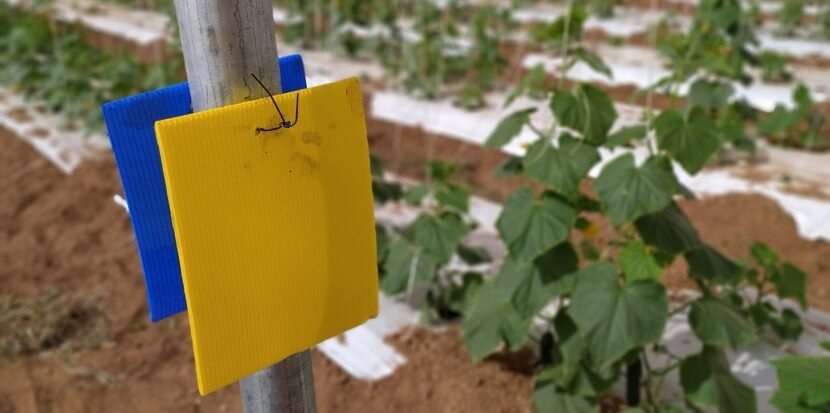
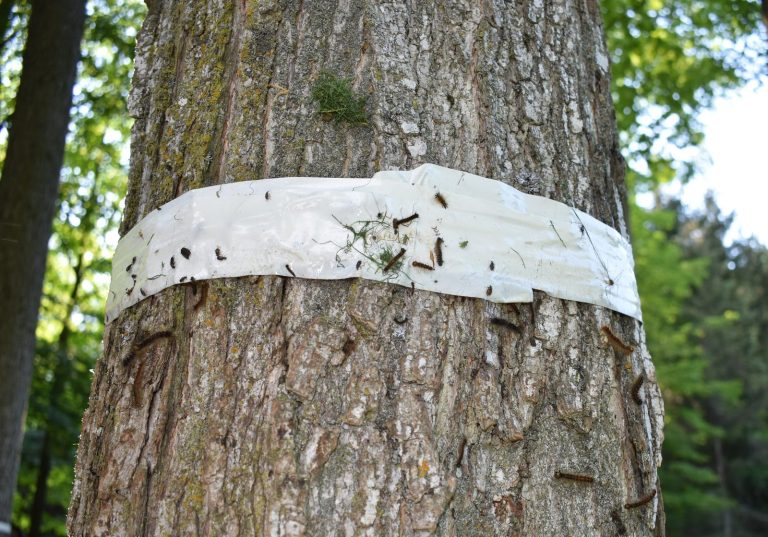
Overhead tape catches flying adults — whitefly, winged aphids, fungus gnats, leafminers, shore flies — in the air column above the crop. Double-sided tape on stems or trunks also intercepts crawlers such as ants and young caterpillars, which cards rarely stop. Blue rolls extend coverage to thrips.
| Pest type | Hanging tape | Cards | Program note |
|---|---|---|---|
| Whitefly adults | Catches at row level | Catches and counts | Tape for pressure, cards for thresholds |
| Winged aphids | Catches in air column | Catches | Run both in early season |
| Fungus gnats | Catches above media | Catches | Tape near media surface |
| Thrips | Blue tape | Blue cards | Match color to pest |
| Crawlers (ants, larvae) | Double-sided tape on stems | Not effective | Tape as barrier |
Installation & Labor: Card Stakes vs. Hanging Rolls
Cards need stakes, holders and individual placement — a full day of labor across a large glasshouse. Rolls run along existing suspension wires; the 50 N/M tensile strength (factory data) lets 100 m rolls feed through mechanical hanging rigs without tearing. One person can cover a full bay in the time it takes to stake part of it.
| Task | Cards | Tape rolls |
|---|---|---|
| Placement | Per-unit, stakes or holders | Run along suspension wires |
| Tools | Stakes, clips | Hanging hooks or rig |
| Re-positioning | Move each card | Shift the whole line |
| Canopy access | Reach every unit | One pass per row |
Durability: UV Life, Heat Flow and Anti-Drip
In warm glasshouses, dripping adhesive is a quality risk on produce. The 700–1200 mPa·s formulation includes anti-flow additives, holding -15°C to 60°C with 90 days of UV-resistant tack (100 W UV, 72 h aging test, no degradation — CNAS). 180° peel strength of ≥15 N/25mm (high-tack ≥25 N/25mm) keeps rolls in place through ventilation cycles; cards share the same adhesive family.
| Parameter | Tape rolls | Cards |
|---|---|---|
| UV-resistant tack | 90 days | 90 days |
| Temperature range | -15°C to 60°C | -15°C to 60°C |
| Anti-drip behavior | Anti-flow additives | Anti-flow additives |
| Peel strength | ≥15 N/25mm (high-tack ≥25 N/25mm) | Same adhesive family |
| Aging test | 100 W UV 72 h, no degradation | Same |

Hybrid IPM Setup: Cards for Monitoring, Tape for Mass Trapping
A practical hybrid: a small grid of cards per bay gives counts and trends; tape lines above the canopy do the heavy lifting during outbreaks. Replace cards when counts pass your action threshold and rotate tape within the 90-day window. Scouting data from card grids justifies tape investment — see our yellow sticky traps professional guide for threshold-based scouting.
Frequently Asked Questions
Which catches more in a heavy whitefly outbreak?
Tape rolls. A single 100 m roll offers roughly 30 m² of double-sided catching surface and saturates far more slowly than cards — the mass-trapping layer during peak flights.
Do tape rolls work for thrips?
Yes — with blue rolls. The factory produces yellow, blue, green and black rolls and thrips respond more strongly to blue, matching the color logic used in its sticky card line.
Can tape replace cards for monitoring?
Not for precise scouting. Cards give countable, per-unit catch data that supports action thresholds; tape is understood as the interception layer. Run both in a hybrid program.
Is the adhesive suitable for residue-free programmes?
The MSDS classifies the adhesive as non-insecticidal with no pesticide actives; materials are REACH and RoHS compliant, backed by a quality-controlled, CE-marked factory.
What are the MOQ and OEM options?
MOQ for OEM programs is 500 units; samples ship within 2 days and custom tooling takes 7 days. OEM covers width, length (2–200 m), core (2.5/5/7.6 cm), coating pattern, liner and private-label printing.
How often should rolls be replaced?
Replace when surface coverage is heavy or before the 90-day UV window expires; in high-pressure zones, rotate weekly to keep interception even across the crop.
References
- U.S. EPA — Integrated Pest Management (IPM) principles
- ECHA — Understanding REACH
- EU — EU Pesticides Database
+86 155 5018 1368
+86 186 6080 2692
+86 188 5516 6509
+86 155 5018 1368
keenfly100@gmail.com
wisetraps.com
Shandong NongZhiWang Agricultural Technology Co., Ltd.
Request a Quote or Free Sample
KEENFLY (Shandong NongZhiWang Agricultural Technology Co., Ltd.) makes this product in our own factory in Shandong, China. Wholesale, OEM and private label: send your target size, glue load, printed artwork and annual volume and we reply with the specification and quotation.
We reply within 24 hours.
WhatsApp: +86 155 5018 1368 / +86 186 6080 2692
WeChat: +86 188 5516 6509 / +86 155 5018 1368
Email: keenfly100@gmail.com

One Comment