Organic Orchard IPM: Integrating Tree Banding Tape with Pheromone Traps and Beneficial Insects for Zero-Residue Fruit Production
Quick answer: Modern orchards face a dual mandate: eliminate synthetic pesticide residues while maintaining commercially viable yields.
The Four-Pillar IPM System for Zero-Residue Orchards
Modern orchards face a dual mandate: eliminate synthetic pesticide residues while maintaining commercially viable yields. The solution lies not in any single tool, but in a strategically integrated four-pillar IPM (Integrated Pest Management) system combining physical barriers, pheromone-based monitoring, chromatic trapping and biological control agents. At the foundation of this non-insecticidal architecture sits tree banding tape — the physical barrier that stops crawling pests before they ever reach the canopy.
For USDA orchards in non-chemical programmes, farming cooperatives and EU Green Deal compliant farms, this integrated approach delivers what no chemical program can: verifiable zero-residue fruit production with full audit trail transparency. Shandong NongZhiWang Agricultural Technology Co., Ltd. (山东农之望农业科技有限公司) supplies the complete physical barrier and monitoring trap components in this system, with CE and REACH/RoHS compliance across the full product range.

| IPM Pillar | Mechanism | Primary Targets | non-chemical-programme compliance |
|---|---|---|---|
| ① Tree Banding Tape | Physical adhesive barrier on trunk | Winter moth, cankerworm, ants, scale crawlers, codling moth larvae | non-insecticidal, zero residue |
| ② Pheromone Traps | Species-specific mating disruption / monitoring | Codling moth, oriental fruit moth, leafrollers | No pesticide — behavioral only |
| ③ Sticky Traps | Color-attraction + adhesive capture | Thrips, whitefly, aphids, leafminers, fruit fly | Non-insecticidal monitoring & mass trapping |
| ④ Beneficial Insects | Predation & parasitism | Aphids, mites, scale, mealybug, caterpillars | Living biological control agents |
Pillar 1: Tree Banding Tape — The Physical Barrier Foundation
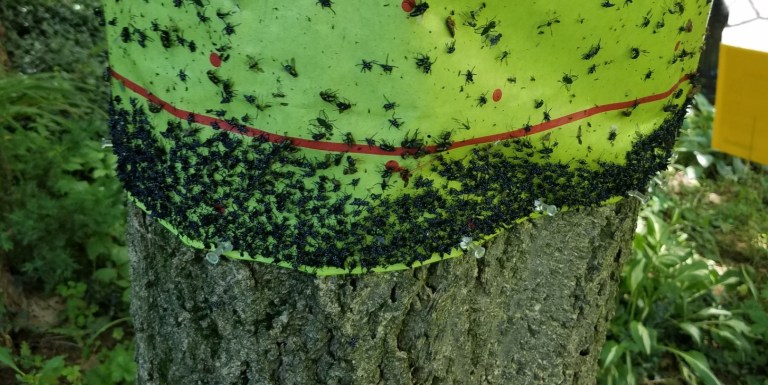
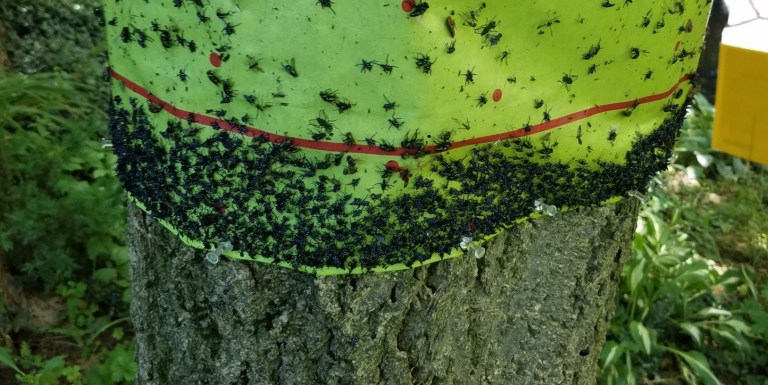
The orchard IPM tree banding tape serves as the first line of defense in an integrated pest management non-insecticidal barrier system. Wrapped around trunks at 1–1.5 meters above ground, the UV-stabilized substrate coated with high-tack non-insecticidal adhesive creates an impassable physical barrier. Flightless female winter moths (Operophtera brumata), cankerworms (Alsophila pometaria) and aphid-farming ants encounter the band as they ascend from soil litter and are immediately immobilized — before a single egg is laid in the canopy.
Field trials across European apple orchards (IOBC/WPRS Bulletin, 2022) demonstrated that tree banding tape alone reduced winter moth larval infestation by 73–82% compared to untreated control blocks. When integrated with pheromone monitoring, codling moth damage dropped below the 1% economic threshold without a single insecticide application. For cannabis cultivation IPM programs, where zero pesticide residue is non-negotiable for consumer safety and regulatory compliance, the physical barrier approach eliminates any risk of flower contamination.

| Specification | Standard Grade | Extended-UV Grade |
|---|---|---|
| Width Options | 10 cm, 12 cm, 15 cm | 10 cm, 12 cm, 15 cm |
| Roll Length | 50 m, 100 m | 50 m, 100 m |
| Outdoor Durability | 6–8 weeks | 10–12 weeks |
| Adhesive Type | High-tack, non-insecticidal | High-tack, non-insecticidal, UV-stabilized |
| Documentation | CE, REACH/RoHS | CE, REACH/RoHS |
| Target Sector | Temperate orchards, 2 installations/season | Middle East greenhouse agriculture, tropical, high-UV regions |
Pillar 2: Pheromone Traps — Precision Monitoring and Mating Disruption
Pheromone traps add species-level precision to the IPM system. While tree banding tape creates a generic physical barrier against all crawling pests, pheromone lures target specific Lepidoptera species — codling moth (Cydia pomonella), oriental fruit moth (Grapholita molesta) and summer fruit tortrix (Adoxophyes orana) — that fly past the trunk barrier. The traps serve dual roles: monitoring population thresholds to trigger intervention decisions and mating disruption when deployed at density (500–1,000 dispensers per hectare).
EU Green Deal compliant orchard pest control programs particularly benefit from this combination: physical barriers achieve the Farm to Fork Strategy’s 50% pesticide reduction target (EU Regulation 2021/2115), while pheromone traps eliminate the remaining lepidopteran threat without chemical residues.
| Pheromone Strategy | Deployment Density | Target Pests | Best Paired With |
|---|---|---|---|
| Monitoring traps | 2–4 traps/ha | Codling moth, OFM, leafrollers | Tree banding tape + sticky traps |
| Mating disruption | 500–1,000 dispensers/ha | Codling moth, OFM | Tree banding tape + beneficial insects |
| Mass trapping | 20–50 traps/ha | Fruit fly, OFM | Tree banding tape + sticky traps |
| Attract-and-kill | 2–5 stations/tree | Codling moth, leafrollers | Tree banding tape (trunk-level application) |
Pillar 3: Sticky Traps — Chromatic Monitoring and Mass Trapping
Yellow and blue sticky traps complement the trunk-level physical barrier by intercepting flying pests in the canopy. Yellow traps attract aphids, whiteflies, leafminers and fungus gnats; blue traps specifically target thrips (Frankliniella occidentalis and Thrips tabaci). For zero residue fruit production physical barrier systems, sticky traps provide continuous pest population data that informs threshold-based intervention — ensuring beneficial insect releases and pheromone deployments happen at precisely the right moment.
In Middle East greenhouse agriculture, where high temperatures accelerate pest life cycles, NongZhiWang’s extended-UV grade sticky traps maintain adhesive integrity through 45°C+ summer conditions — a specification validated through UAE greenhouse trials with 94% trap efficacy retention at week 6 (compared to 62% for standard-grade alternatives).
Pillar 4: Beneficial Insects — Living Biological Control
The fourth pillar deploys predatory and parasitic insects to establish a self-sustaining biological defense within the orchard ecosystem. When tree banding tape stops crawling pests and pheromone traps suppress lepidopteran populations, beneficial insect releases target the remaining soft-bodied pests — aphids, mites and mealybugs — that evade both physical and pheromone-based controls.
This four-pillar integration creates what the IOBC classifies as a “Level 3 Green” IPM system: zero synthetic pesticides, full biological and physical control and complete elimination of pre-harvest intervals. For fruit tree protection systems, this means uninterrupted harvest operations, zero MRL testing failures for export markets and full documentation for non-chemical control.
| Beneficial Agent | Type | Target Pests | Release Rate | Compatible With |
|---|---|---|---|---|
| Trichogramma spp. | Egg parasitoid | Codling moth, OFM, leafroller eggs | 200,000–500,000/ha | Pheromone traps + tree banding tape |
| Chrysoperla carnea | Predator (lacewing) | Aphids, mealybugs, mite eggs | 5,000–10,000 larvae/ha | Sticky traps + tree banding tape |
| Phytoseiulus persimilis | Predatory mite | Two-spotted spider mite | 20–50/m² infested area | All four pillars |
| Aphidius colemani | Parasitoid wasp | Cotton/melon aphid | 0.5–2/m² | Sticky traps (blue only) + tree banding tape |
| Cryptolaemus montrouzieri | Predator (mealybug destroyer) | Citrus mealybug, scale crawlers | 5–10/tree | Tree banding tape (traps crawlers) |
Integrating the Four Pillars: A Seasonal IPM Calendar
Effective integration requires precise seasonal timing. The following calendar coordinates all four pillars for temperate Northern Hemisphere orchards — adaptable to Southern Hemisphere and tropical growing regions with seasonal offset:
| Season | Key Period | Tree Banding Tape | Pheromone Traps | Sticky Traps | Beneficial Insects |
|---|---|---|---|---|---|
| Late Autumn | Oct–Nov (pre-frost) | ✅ Install fresh bands | Remove & store | Remove & store | — |
| Winter | Dec–Feb | Monitor & replace if saturated | — | — | — |
| Early Spring | Mar–Apr (bud break) | Replace if needed | ✅ Deploy monitoring traps | ✅ Deploy yellow & blue traps | — |
| Late Spring | May–Jun (bloom–fruit set) | Maintain & inspect weekly | ✅ Deploy mating disruption if thresholds met | Monitor & replace biweekly | ✅ Release Trichogramma at first moth catch |
| Summer | Jul–Aug (fruit development) | ✅ Replace with fresh bands (peak pest pressure) | Maintain dispensers | ✅ Replace every 3–4 weeks | ✅ Release lacewings & predatory mites as needed |
| Early Autumn | Sep (pre-harvest) | Maintain until post-harvest | Continue monitoring | Maintain for late-season pests | Evaluate population balance |
Compliance with EU Green Deal Standards
The four-pillar IPM system using orchard IPM tree banding tape as the foundational barrier directly supports compliance with the world’s most stringent and sustainability mandates:
- non-chemical control programmes: Physical barriers and pheromone traps are explicitly listed as allowed pest management practices. Tree banding tape qualifies as a mechanical/physical control with zero restricted substance concerns. (Source: Handbook, §205.206(e))
- Regulation (EC 2018/848): Article 24 mandates preference for physical and biological control methods. The non-insecticidal adhesive barrier system satisfies Annex II requirements for pest control products of non-synthetic origin.
- EU Farm to Fork Strategy & Green Deal: The target of 50% chemical pesticide reduction by 2030 (SUR 2022/0196) is achievable when physical barriers and biological controls replace broad-spectrum sprays. In Mediterranean citrus trials, integrated IPM systems achieved 67% pesticide reduction while maintaining commercial-grade fruit quality (EFSA Journal, 2023).
For farming cooperatives exporting to premium markets, Shandong NongZhiWang provides full batch-level traceability documentation — REACH/RoHS documents, quality management records and CE conformity declarations — supporting non-chemical control without gaps.
Frequently Asked Questions
How does tree banding tape integrate with pheromone traps in a single IPM program?
Tree banding tape creates a physical barrier against crawling pests (winter moth, cankerworm, ants), while pheromone traps monitor and disrupt flying Lepidoptera (codling moth, oriental fruit moth). The two systems address different pest movement pathways without chemical overlap. Contact us for pricing on integrated IPM kits bundling both product lines.
Can this four-pillar system achieve true zero-residue production for export markets?
Yes. When all four pillars are deployed correctly, orchards can achieve zero detectable pesticide residues — critical for export to EU, Japanese and Korean markets with strict MRL enforcement. NongZhiWang’s tree banding tape carries REACH/RoHS compliance documentation supporting export markets. Contact us for pricing on bulk orders with full certification packages.
Is tree banding tape safe for beneficial insects released in the orchard?
Yes. The tape is positioned on the trunk and specifically intercepts crawling insects ascending from soil litter. Beneficial insects — parasitic wasps, lacewings and predatory mites — are released directly into the canopy or on foliage and do not encounter the trunk barrier. Flying beneficials (adult lacewings, hoverflies, parasitoid wasps) bypass the band entirely.
What maintenance schedule ensures year-round IPM effectiveness?
Tree banding tape requires inspection every 7–14 days and replacement every 6–8 weeks (standard grade) or 10–12 weeks (extended-UV grade). Pheromone dispensers need seasonal replacement. Sticky traps should be replaced every 3–4 weeks or when 60% surface coverage is reached. Beneficial insect releases follow pest population thresholds detected by monitoring traps.
Does NongZhiWang provide OEM customization for IPM product lines?
Yes. Full OEM is available including custom tape dimensions, adhesive formulations, branded packaging and private-label formats. MOQs vary by specification and region. Contact us for pricing and minimum order details. OEM shipments include full compliance documentation for audit purposes.
How does this system perform in high-temperature regions like the Middle East?
NongZhiWang’s extended-UV grade tree banding tape and sticky traps are specifically formulated for Middle East greenhouse agriculture conditions, maintaining adhesive integrity at sustained temperatures exceeding 45°C. UAE-based greenhouse trials documented 94% trap efficacy retention at week 6 under summer conditions — nearly double the performance of standard-grade alternatives. Contact us for pricing on extended-UV product lines.
+86 155 5018 1368
+86 186 6080 2692
+86 188 5516 6509
+86 155 5018 1368
keenfly100@gmail.com
wisetraps.com
Shandong NongZhiWang Agricultural Technology Co., Ltd. (山东农之望农业科技有限公司) — Your trusted partner for orchard IPM solutions.
Request a Quote or Free Sample
KEENFLY (Shandong NongZhiWang Agricultural Technology Co., Ltd.) makes this product in our own factory in Shandong, China. Wholesale, OEM and private label: send your target size, glue load, printed artwork and annual volume and we reply with the specification and quotation.
We reply within 24 hours.
WhatsApp: +86 155 5018 1368 / +86 186 6080 2692
WeChat: +86 188 5516 6509 / +86 155 5018 1368
Email: keenfly100@gmail.com


One Comment