Blue Sticky Traps vs Yellow for Thrips Control: Greenhouse IPM with Sticky Tape
Quick answer: Thrips are the greenhouse pest that keeps surprising: tiny, fast and capable of vectoring tomato spotted wilt virus while yellow traps fill with whiteflies.
Thrips are the greenhouse pest that keeps surprising: tiny, fast and capable of vectoring tomato spotted wilt virus while yellow traps fill with whiteflies. The fix starts with color: blue sticky traps catch thrips more reliably than yellow, yet most greenhouse programs default to yellow cards. For greenhouse wholesale suppliers, hydroponic growers, PCO pest control distributors and orchard pest management programs, the blue-versus-yellow decision determines whether monitoring sees the pest. This guide covers the color science, head-to-head comparison and the sticky tape combination for a complete perimeter.
Why Color Matters: Blue vs Yellow Sticky Traps
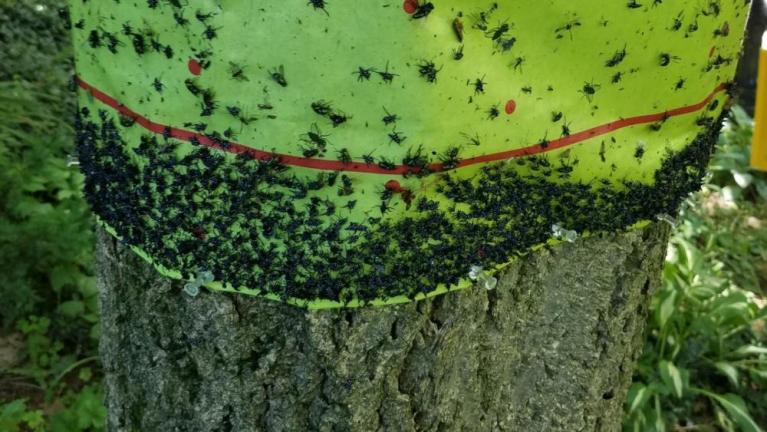
Sticky traps are color lures: insects respond to specific reflectance bands, fly toward the card and stick. Yellow cards are broad-spectrum — pulling whiteflies, aphids, leafminers and fungus gnats — which is why they dominate the market. Blue cards target a narrower but critical group: thrips. The University of Florida/IFAS Featured Creatures collection documents thrips biology and greenhouse programs consistently report blue cards outperforming yellow for thrips monitoring.
Thrips Biology: Why They Respond to Blue (465nm) and Yellow (570nm)
Western flower thrips (Frankliniella occidentalis) and onion thrips (Thrips tabaci) are strongly attracted to blue-violet wavelengths around 465 nm, while aphids and whiteflies respond most to yellow near 570 nm. Thrips also linger on blue-violet targets, so a blue card beside a yellow card catches thrips on one and whiteflies on the other — a one-color program misses its key pest. Because thrips hide in buds and flowers, traps are the primary early-warning system: check cards weekly, count thrips per card, intervene before populations explode. The Blue Sticky Traps for Thrips: Professional Sourcing Guide details monitoring protocols wholesalers pass to growers.
Blue Traps vs Yellow Traps: Head-to-Head Comparison
| Feature | Blue Traps | Yellow Traps |
|---|---|---|
| Primary targets | Thrips (flower, onion, melon) | Whitefly, aphids, leafminer, fungus gnats |
| Optimal wavelength | ~465 nm blue-violet | ~570 nm yellow |
| Best role | Thrips monitoring & mass trapping | Broad-spectrum monitoring |
| Typical placement | Just above canopy, near buds | Crop level, vents and doorways |
| IPM compatibility | Pairs with yellow cards and tape | Pairs with blue cards and tape |
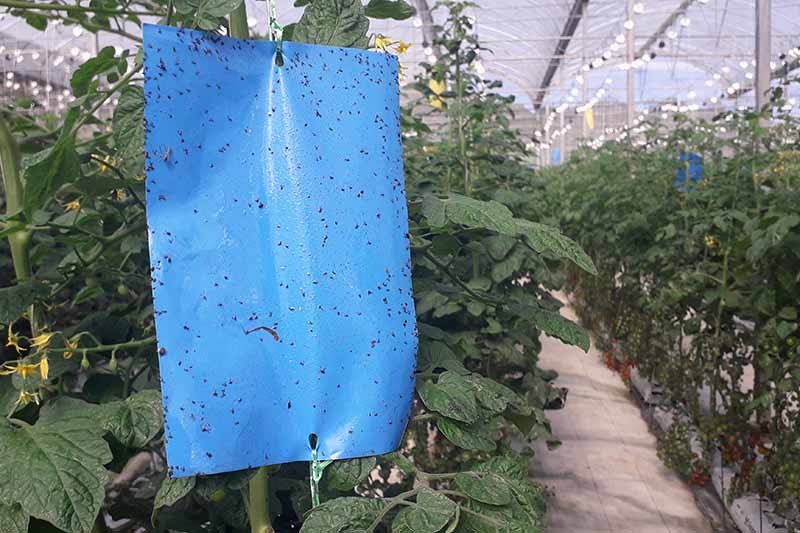
Combining Sticky Traps with Sticky Tape for Greenhouse IPM
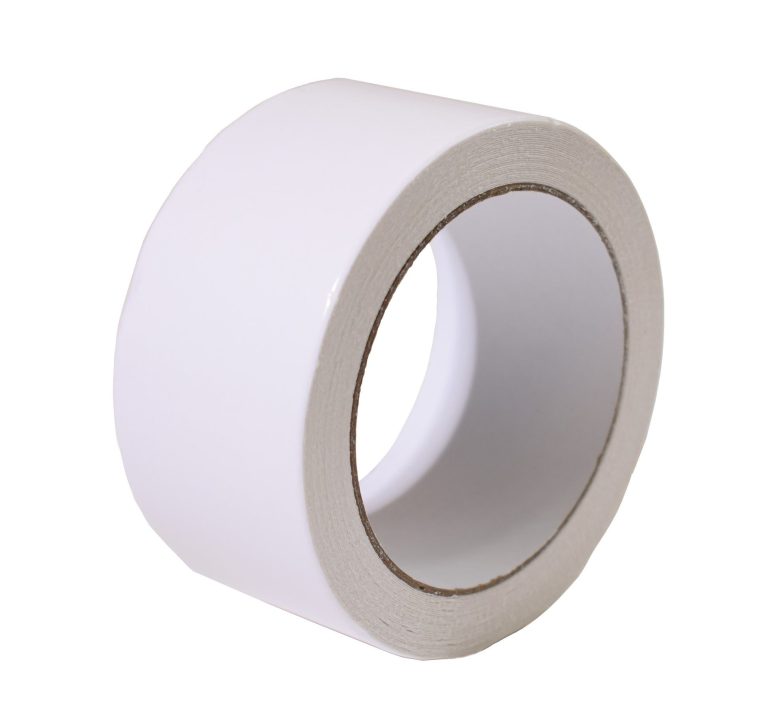
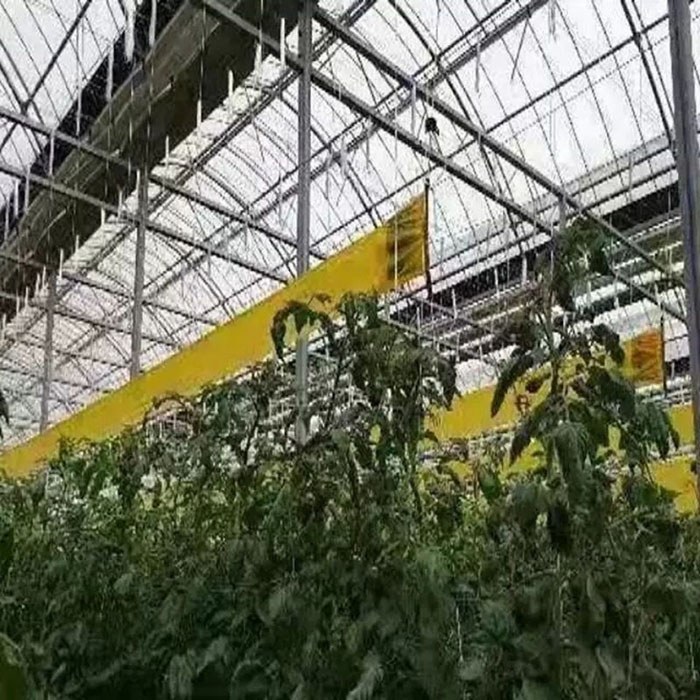
Cards give you the data; tape gives you the perimeter. Double-sided yellow sticky tape rolls (5 cm × 100 m) hang along vents, doorways and crop rows to intercept flying adults, while blue cards monitor thrips inside the block. Our cards and tape share one adhesive platform, so replacement schedules stay consistent — the Sticky Tape vs Sticky Cards: IPM Guide compares both formats.
| Parameter | Typical Specification |
|---|---|
| Substrate | PE/CPP film (cards and tape rolls) |
| Thickness | 7–150 micron-class |
| Adhesive viscosity | 700–1200 mPa·s |
| Coating weight | 30–600 g/m², single- or double-sided |
| UV / temperature | 90 days outdoor tack; -15°C to 60°C |
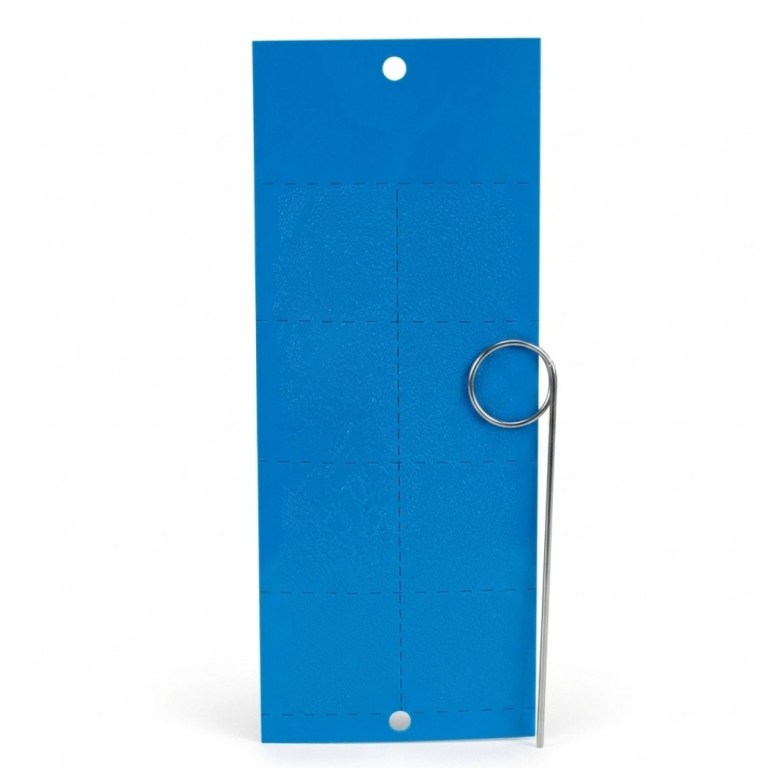
| Formats | Cards 10×25 cm / A5; tape 5 cm × 100 m |
Deployment Strategy: Trap Density & Placement
Placement beats quantity. Hang cards just above the canopy — thrips fly low and land on the brightest target — and add tape at vents, doors and gutter level. A common starting point is 5–10 cards per 1,000 m², doubled near incoming plant material; adjust weekly. Replace cards and tape when the adhesive is heavily loaded or after roughly 90 days.
| Crop | Recommended Color | Placement |
|---|---|---|
| Tomato / pepper | Blue | Just above canopy, near flowering trusses |
| Cucumber | Blue + yellow mix | Crop level, plus overhead tape |
| Ornamentals | Blue | Above benches, near vents |
| Strawberry / soft fruit | Blue + yellow | Canopy edges and row ends |

Sourcing Considerations for Wholesale Buyers
Greenhouse wholesale suppliers and PCO pest control distributors buying in volume should specify substrate, coating weight, release liner and double-sided coating in the RFQ and verify compliance documentation before the first container. Ours covers compliance documentation, MSDS (non-insecticidal), CNAS/CE and 100% REACH/RoHS compliance, aligned with the EU Pesticides Database and the U.S. EPA pesticide framework.
| Documentation | Applicability |
|---|---|
| Quality-controlled production facility (USA) | North American market entry |
| MSDS | non-insecticidal documentation; global freight |
| CNAS / CE | National laboratory testing; EU channel access |
| REACH & RoHS | 100% compliance; EU and US market access |
OEM buyers can private-label blue cards, yellow cards and 100 m tape rolls from our 10,000 m², three-site factory with 500,000+ units daily capacity. Share your crop mix, trap density and annual volume for specs, samples and lead times. The Yellow Sticky Traps: Professional Guide (2026) helps build the complementary SKU set. Contact us for pricing.
Frequently Asked Questions
Why are blue traps better for thrips?
Thrips are strongly attracted to blue-violet light around 465 nm, while yellow (570 nm) pulls whiteflies and aphids, so blue cards catch thrips earlier and in higher numbers.
Should we run blue or yellow traps?
Run both in a mixed IPM program: blue for thrips, yellow for whitefly, aphids and leafminers — the two colors catch different pests in the same row.
How often should traps and tape be replaced?
Check cards weekly; replace when the adhesive is heavily loaded or after roughly 90 days of UV exposure.
Are sticky traps and tape safe around edible crops?
Yes — physical devices with no active ingredient; the MSDS documents non-insecticidal status and no residue on produce.
Can we OEM blue cards or tape with our own label?
Yes — custom size, color, printing and private-label packaging for cards and tape rolls. Contact us for pricing.
What does a distributor order look like?
Share your crop mix, trap density and annual volume via WhatsApp, WeChat or email; orders ship with EPA/CE/REACH/RoHS documentation.
Contact Shandong NongZhiWang Agricultural Technology Co., Ltd. (山东农之望农业科技有限公司)
+86 155 5018 1368
+86 186 6080 2692
+86 188 5516 6509
+86 155 5018 1368
keenfly100@gmail.com
wisetraps.com
Request a Quote or Free Sample
KEENFLY (Shandong NongZhiWang Agricultural Technology Co., Ltd.) makes this product in our own factory in Shandong, China. Wholesale, OEM and private label: send your target size, glue load, printed artwork and annual volume and we reply with the specification and quotation.
We reply within 24 hours.
WhatsApp: +86 155 5018 1368 / +86 186 6080 2692
WeChat: +86 188 5516 6509 / +86 155 5018 1368
Email: keenfly100@gmail.com