Tree Banding Tape Installation Guide | Shandong NongZhiWang
Tree Banding Tape Installation Guide | Shandong NongZhiWang
Orchard growers across North America and Europe face mounting pressure to reduce chemical pesticide use while maintaining crop yields. Tree banding tape offers a proven physical barrier method that targets crawling insects before they reach fruit and foliage. This guide covers specifications, selection, and installation for commercial orchard operations.
Why Physical Barriers Outperform Chemical Sprays
Caterpillars, ants, scale insects, and borers travel along tree trunks to access canopies. A sticky barrier intercepts these pests at trunk level, reducing foliar sprays. Physical barriers eliminate re-entry intervals, protect pollinators, and comply with organic standards such as OMRI and EU Organic.
For large-scale orchards, tree banding tape provides cost-effective monitoring and mass-trapping. Growers track pest pressure through trap counts, enabling data-driven spray decisions rather than calendar-based applications.
Product Range: Widths and Formats
5 cm Narrow Tape
The 5 cm width targets small crawling insects such as aphids, mealybugs, and ants. Available in rolls of 20 m, 30 m, and 100 m, this format suits young trees with smooth bark and vineyard trellis systems.
10 cm Standard Width
A 10 cm band provides wider trapping surface for leafrollers, codling moth larvae, and scale crawlers. Roll lengths of 50 m and 100 m are standard for commercial orchards. This width balances adhesive capacity with ease of application on citrus, apple, and stone fruit trees.
15 cm Heavy-Duty Width
The 15 cm format is designed for thick-barked species such as walnut, pecan, and mature oak. The wider band compensates for bark crevices. Industrial-grade adhesive maintains tack from minus 20 to 60 degrees Celsius.

Material and Adhesive Specifications
Tree banding tape is manufactured from UV-stabilized polypropylene (PP) or polyethylene (PE) film with pressure-sensitive adhesive coating.
| Specification | Standard Grade | Heavy-Duty Grade |
|---|---|---|
| Substrate | PP film 0.05 mm | PE film 0.08 mm |
| Adhesive type | Permanent acrylic | High-tack rubber |
| Temperature range | Minus 10 to 50 °C | Minus 20 to 60 °C |
| UV resistance | 6 months outdoor | 12 months outdoor |
| Water resistance | Waterproof | Waterproof, rain-resistant |
| Double-sided option | Available | Available |
Heavy-duty PE variants withstand mechanical stress during harvest operations and trunk movement in wind.
Step-by-Step Installation
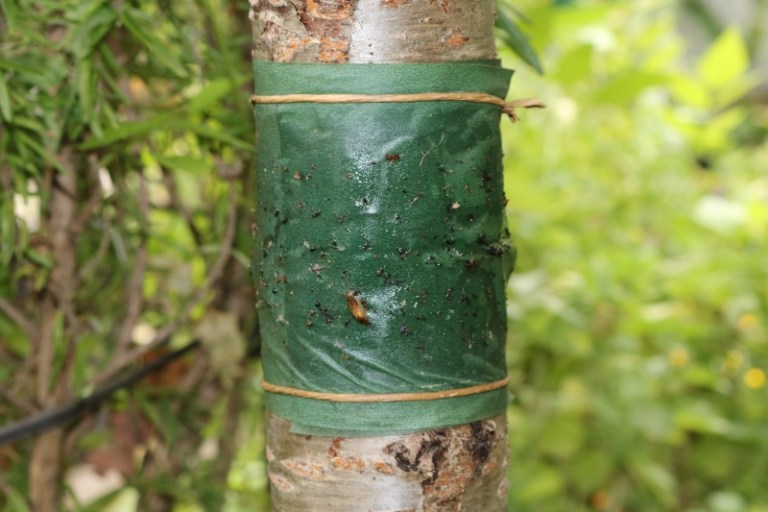
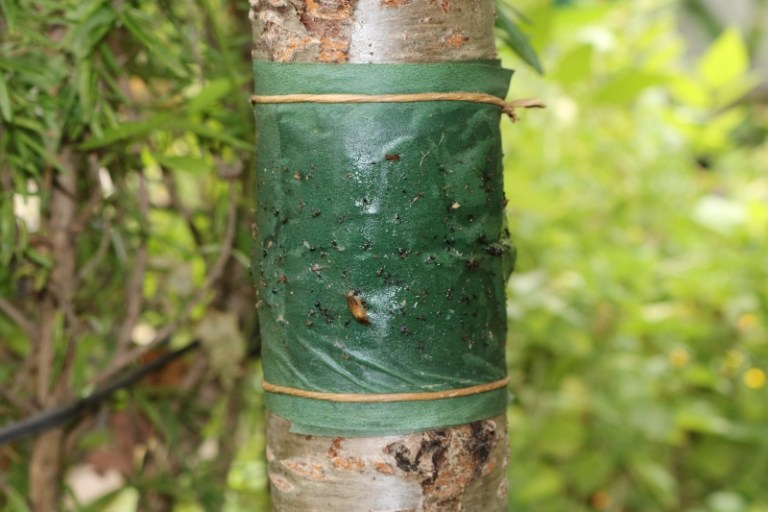
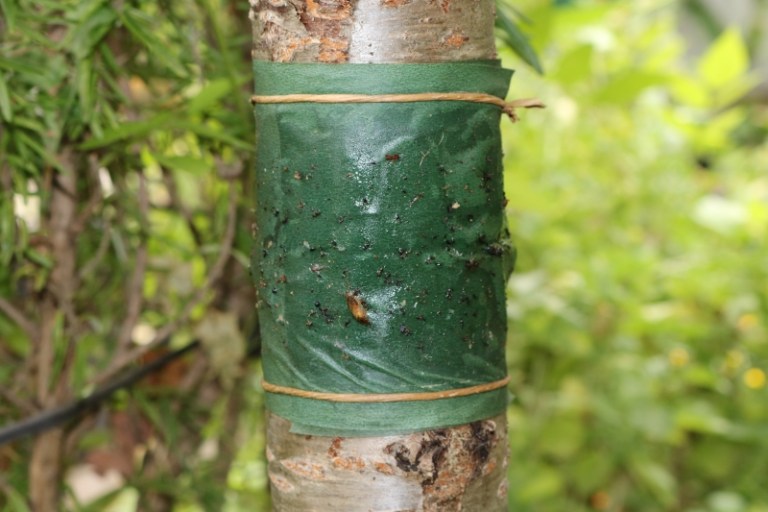
Step 1: Trunk Preparation — Remove loose bark, moss, and debris from the banding zone. A clean surface ensures full adhesive contact.
Step 2: Band Positioning — Apply tape at 30 to 50 cm above ground level, below the first branching point. Band each trunk individually on multi-trunk trees.
Step 3: Overlap and Seal — Overlap tape ends by 5 cm and press firmly. Ensure no gaps at the seam where insects could pass through.
Step 4: Monitor and Replace — Inspect weekly during peak pest season. Replace when adhesive surface is more than 70 percent covered with trapped insects or debris.
Double-Sided vs Single-Sided Selection
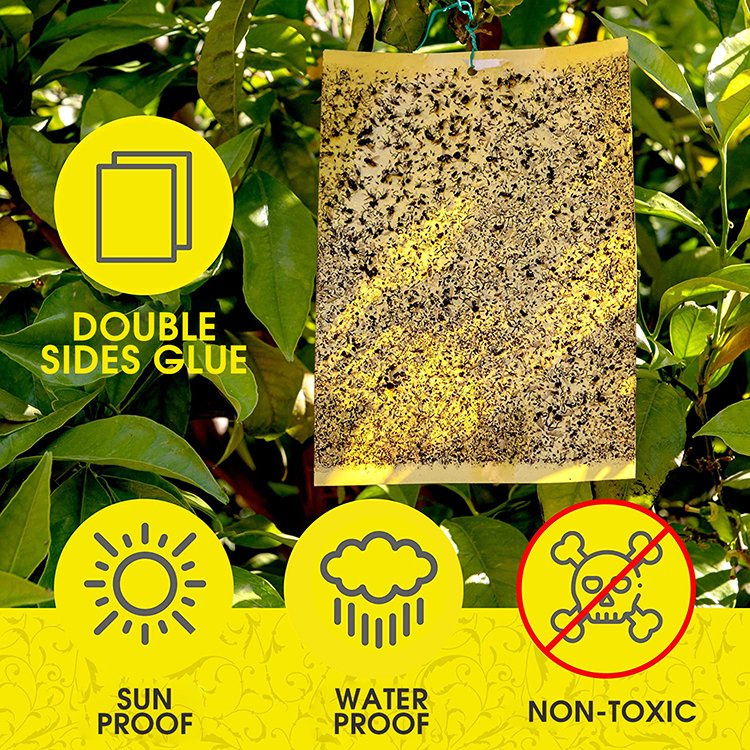
Double-sided tape captures insects approaching from both ground level and canopy descent, ideal for monitoring pest pressure. Single-sided tape with adhesive facing outward is preferred for mass-trapping during high-pressure periods.
For orchards transitioning to integrated pest management (IPM) programs, start with double-sided tape for baseline pest counts, then switch to single-sided heavy-duty tape during outbreak periods.
Factory-Direct Sourcing
Direct procurement eliminates distributor markups and ensures consistent adhesive quality. Minimum orders start at 500 rolls, with custom printing, width, and core size for OEM orders.
| Order Volume | Lead Time | Custom Options |
|---|---|---|
| 500-2,000 rolls | 15-20 days | Width, core diameter |
| 2,000-10,000 rolls | 20-25 days | Width, color, packaging |
| 10,000+ rolls | 25-30 days | Full OEM: width, print, label |
Shandong NongZhiWang operates ISO 9001-certified production lines with monthly capacity exceeding 2 million rolls. All products pass EU REACH and EPA adhesive compliance testing before shipment.
Frequently Asked Questions
Q1: What insects does tree banding tape effectively trap?
A: Tree banding tape intercepts crawling pests including codling moth larvae, gypsy moth caterpillars, ants, scale insects, leafrollers, and borers. The adhesive captures insects as they travel along the trunk between soil and canopy.
Q2: How long does the adhesive remain effective outdoors?
A: Standard-grade adhesive maintains tack for 6 months under normal UV exposure. Heavy-duty formulations with UV stabilizers remain effective for up to 12 months in temperate climates.
Q3: Can tree banding tape be used on organic-certified orchards?
A: Yes. Tree banding tape is a physical control method that does not introduce chemical residues. It qualifies under OMRI, EU Organic, and USDA National Organic Program guidelines.
Q4: What tape width works best for walnut and pecan trees?
A: Walnut and pecan trees with thick, deeply furrowed bark require 15 cm wide tape. The wider band compensates for bark crevices and provides sufficient adhesive surface to intercept borers effectively.
Q5: How should tape be disposed of after use?
A: Used tape can be collected and disposed of according to local plastic waste regulations. The PP or PE substrate is recyclable in facilities that accept mixed plastic film.
Q6: What is the minimum order for factory-direct tree banding tape?
A: Minimum order quantities start at 500 rolls for standard widths (5 cm, 10 cm, 15 cm). Custom widths, core sizes, and branded packaging are available for orders above 2,000 rolls. Contact us for pricing and lead time details.
Contact Us
+86 155 5018 1368
+86 186 6080 2692
+86 188 5516 6509
+86 155 5018 1368
Email & Web
keenfly100@gmail.com
wisetraps.com
Shandong NongZhiWang Agricultural Technology Co., Ltd.