
Tree Banding Tape for Windbreaks | Shandong NongZhiWang
Windbreaks and shelterbelts are planted for soil, wind and livestock comfort, yet the same linear rows of trees collect the crawling pest pressure normally associated with orchards. Aphids, scale crawlers and climbing ants use the trunk as a highway, and defoliating caterpillars walk up and down it. Shandong NongZhiWang is a tree banding tape orchard wholesale manufacturer supplying tree banding tape wholesale programs to shelterbelt contractors, conservation nurseries, farm forestry suppliers and forestry pest management supplies wholesale buyers worldwide.
What Climbs a Shelterbelt Row
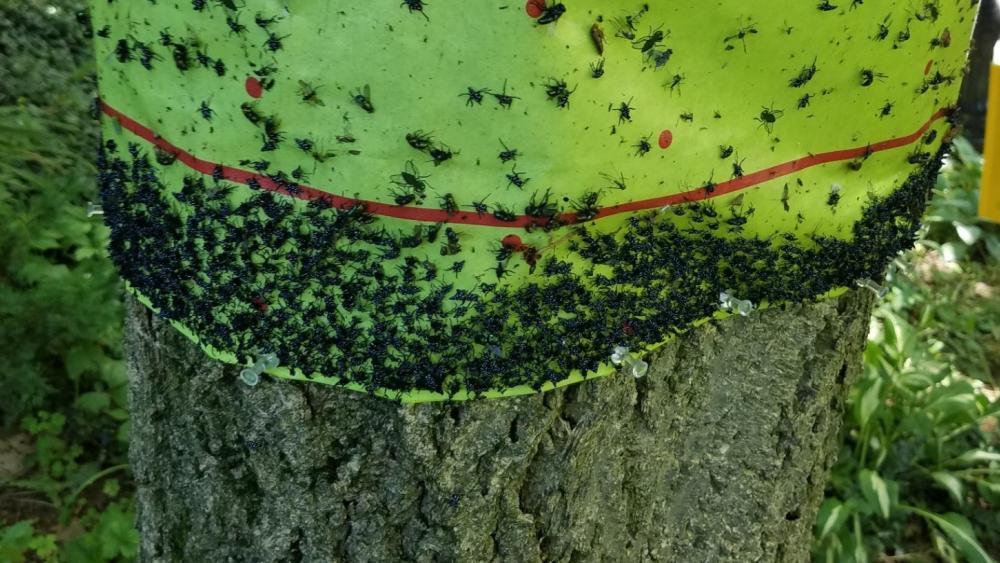
Aphids on windbreak and shade trees feed on new growth and excrete honeydew, which coats branches and bark and supports sooty mold; ants then tend the aphids and interfere with the natural enemies that would otherwise hold them back. Wingless female cankerworm moths emerge from the soil and crawl up the trunk to lay eggs in the canopy, and spongy moth caterpillars move along trunks between the ground and the crown. A continuous sticky band interrupts all of that traffic. In practice it does three jobs at once: it blocks climbing ants and aphid crawlers, it catches climbing and descending caterpillars, and it acts as a scouting strip that shows crews what is moving before a spray decision is made.
What to Specify for Row Plantings
Shelterbelt and windbreak rows are installed by the thousand stems, so the specification has to survive tender young bark, dust, frost and a season of neglect. The table below is the configuration we ship most often for conservation and agroforestry planting programs.
| Backing | PE / CPP film, 0.07–1.5 mm, single or double sided |
| Width | 50 / 75 / 100 / 120 / 150 mm |
| Roll length | 20 / 30 / 50 / 100 m, cores 2.5 / 5 / 7.6 cm |
| Adhesive | 700–1200 mPa·s, coating weight 30–600 g/m² |
| Service range | −15 to 60 °C, UV exposure ≈ 90 days, peel ≥ 15 N/25 mm |
Wider bands such as the 120–150 mm black grade are specified where bark is rough or where one crawler barrier ribbon must carry a full season on orchard banding tape runs along the field edge; narrower 50–75 mm rolls cover most young deciduous stems. For widths, roll lengths, cores and carton layouts, see our tree banding tape wholesale specifications guide.
Placement Practice That Holds Up in the Field
Extension guidance on bands is consistent on four points. Do not press adhesive onto bark: seat the tape on a paper or cloth buffer, or use the film backing, so the trunk is not injured. Put bands in place before the seasonal climb begins, since a band installed after the moths or caterpillars are already moving only catches part of the population. Remove the bridges that defeat a band: mow the base skirt, prune low side growth and cut any branch or weed touching the trunk. Use a working width of 10–12 cm, check the strips through the season, and re-seat them once the adhesive is loaded. Inspect for non-target visitors and release any trapped bird or small mammal by covering the adhesive and lifting the band off whole.
Supply Program for Nurseries and Contractors
A shelterbelt program usually mixes widths by stem size, splits quantity across two or three deliveries so crews can take stock by phase, and carries the contractor or nursery brand on the carton. We support mixed-width pallets, printed logo and custom labelling, barcode-ready cartons, sample rolls, and documentation for public-tender and municipal forestry pest barrier style procurement. Send the stem count, spacing, trunk diameter range, installation window and destination port and we will return a single reply covering specification, pack and freight. For agricultural pest control products wholesale programs that combine bands with monitoring cards, the same shipment can be consolidated. Contact us for pricing and availability.
FAQ
Can tree banding tape go on young shelterbelt saplings?
Yes. On thin-bark species use the narrower 50–75 mm rolls over a paper buffer and seat them flat so no gap opens underneath where crawlers could pass.
When should a new planting be banded?
Before the seasonal climb starts: late winter for spring-emerging moths and crawlers, with a second check in summer where generations overlap. Bands installed early catch the first wave instead of part of it.
How wide should the band be on a windbreak trunk?
Around 10–12 cm for most deciduous and conifer stems, wider on rough-barked mature trees. Too narrow a band fills up quickly and lets crawlers cross on debris.
Does the band replace spraying?
It is a physical barrier and a monitoring strip, not a treatment. Many programs use bands to cut climbing traffic and to time any intervention, following local label and registration rules.
Can you supply our brand and pack?
Yes: printed logo, custom labelling, retail or bulk packaging and barcode-ready cartons. Send artwork and pack format and we will confirm minimum order quantity.
How should a contractor order for the season?
Order ahead of installation with width, roll length, quantity and destination port, and contact us for one reply covering lead time and freight.
Contact Shandong NongZhiWang
Planning a banding program for a windbreak, shelterbelt or conservation planting? Contact us for wholesale offers, samples and custom specifications.
| +86 155 5018 1368 | |
| +86 186 6080 2692 | |
| +86 188 5516 6509 | |
| +86 155 5018 1368 | |
| keenfly100@gmail.com | |
| Website | wisetraps.com |
Shandong NongZhiWang Agricultural Technology Co., Ltd. (山东农之望农业科技有限公司)
Recommended Products
- Yellow Tree Banding Tape 10 cm × 30 m — Double-Sided Orchard Crawler Barrier
- Black Tree Banding Tape 10 cm × 100 m — Crawler Barrier Ribbon for Landscape and Urban Forestry Trees
- Non-Toxic Tree Banding Tape — Crawler Barrier for Orchard and Forestry Pest Control