Nursery Tree Banding: Protecting Liners and Young Trees
Quick answer: Nursery liners and young trees can look fine one week and ragged the next. The damage usually crawls up the trunk overnight: cutworms, root weevils, ants tending aphids, or wingless winter moth and cankerworm females climbing from the soil into the canopy.
Nursery liners and young trees can look fine one week and ragged the next. The damage usually crawls up the trunk overnight: cutworms, root weevils, ants tending aphids, or wingless winter moth and cankerworm females climbing from the soil into the canopy. A roll of sticky tree banding tape stops that traffic before it reaches the first branch. For growers who ship thousands of potted liners a season, that thin band is cheap insurance in tree nursery pest control.
Why Nursery Liners Need a Trunk Barrier
Young trees are tempting targets. Their bark is thin, their growth flush is soft and every spring flush brings a fresh wave of crawlers. Potted liners are worse: the pot edge sits at soil level, so ants and root weevils walk straight from the pot wall onto the stem. Bare-root saplings in rows face the same problem — pests move trunk to trunk without touching the ground.
Penn State Extension has documented how wingless winter moth females climb trunks from late fall through winter to lay eggs and how sticky trunk bands intercept them first. Cornell IPM programs apply the same logic to cankerworm and ant management: a band on the trunk breaks the crawl path with no insecticide residue on the plant. In a nursery, clean stock is the product.
| Pest | How it damages young trees | Main crawl window | Why a trunk band works |
|---|---|---|---|
| Winter moth / cankerworm females | Climb trunk; larvae feed on leaves | Late fall – early spring | Band blocks climb before egg-laying (Penn State Extension) |
| Ants | Tend aphids and scale, spread sooty mold | Spring – summer | Breaks ant trails from soil to canopy (Cornell IPM) |
| Root weevil adults | Chew liner bark, girdle saplings | Night crawls, May – August | Adults trapped while climbing to feed |
| Cutworms | Sever young stems at soil line | Spring, early summer | Band at the base stops upward movement |
How Sticky Tree Banding Works
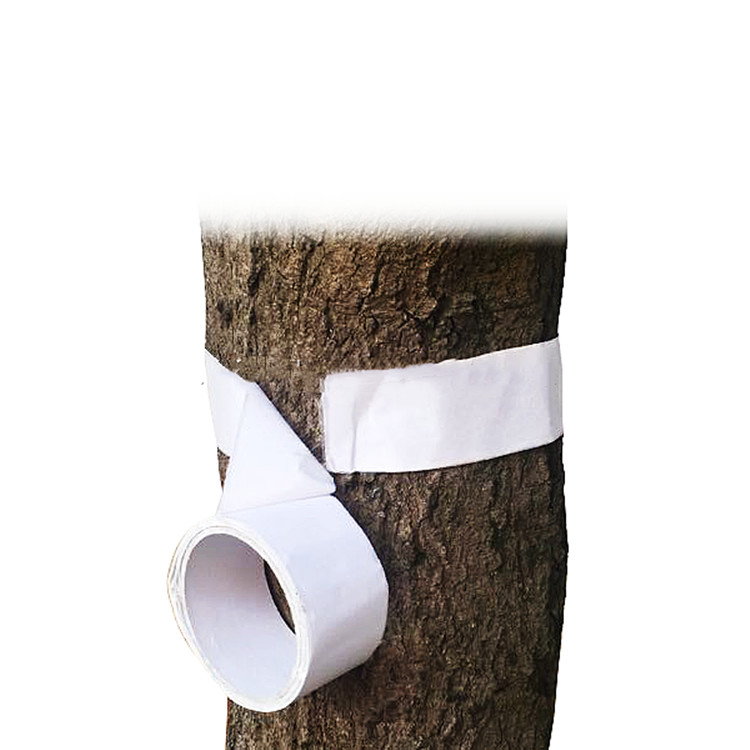
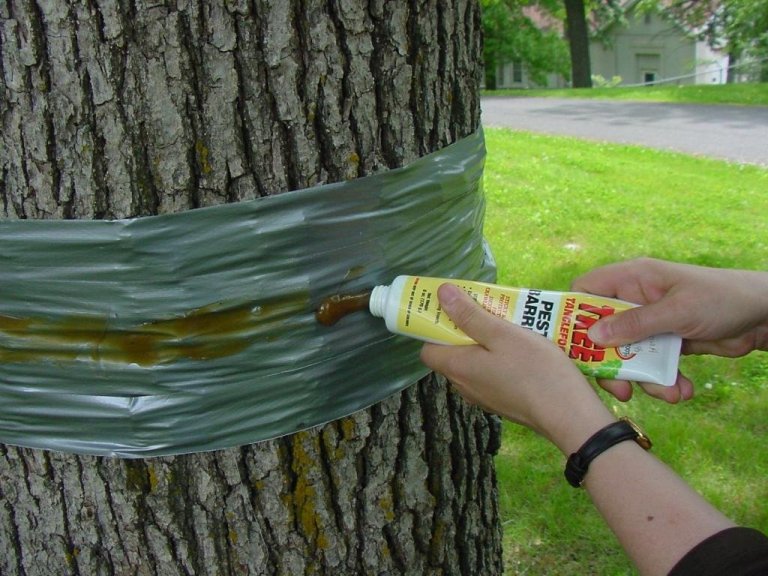
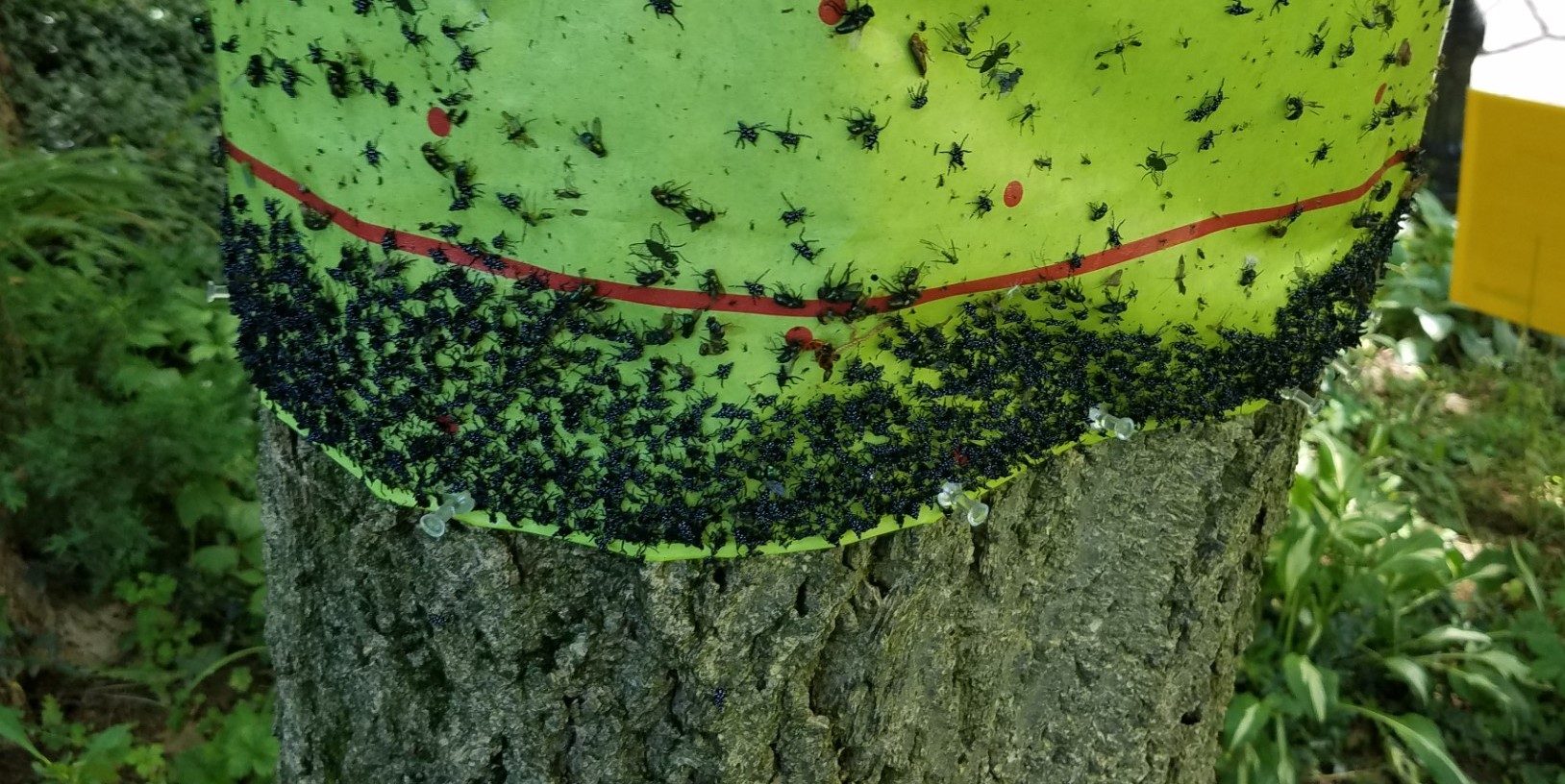
The principle is simple. Wrap a band of adhesive-coated film around the trunk at about 30–50 cm above the soil line, snug and smooth and any insect that tries to cross it sticks. No insecticide enters the plant, no spray drift lands on neighboring liners. The adhesive stays tacky outdoors for a full season: our formulation holds active stickiness for 90 days under direct sun and works from -15°C to 60°C, covering cold-frame winters and summer heat alike.
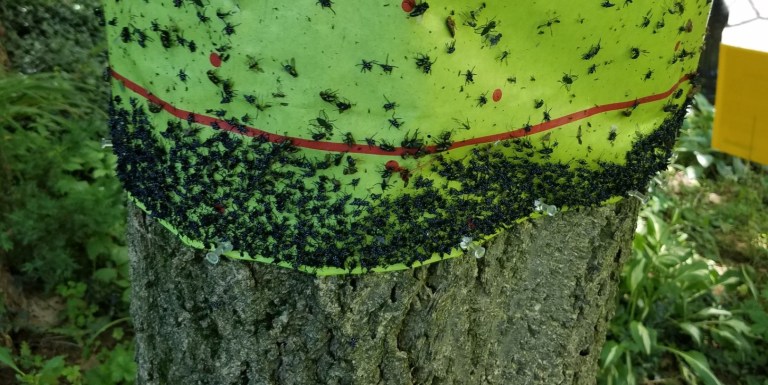
The tape doubles as a monitoring tool. Check the band weekly and you will see which pests are moving, when and in what numbers — turning a blind spray program into a decision you can see. The product we stock for this job is the non-insecticidal crawler barrier ribbon, coated on one or both sides depending on whether you block an upward climb or catch traffic from both directions.
Choosing the Right Band Width for Liners and Saplings
Nursery trunks are thin, so wide bands waste material. Match band width to trunk diameter, not to the mature tree the liner will become. A 5 cm strip suits most potted liners and first-year saplings; step up to 10 cm for caliper and grafted stock. Our factory cuts widths from 1 cm to 1,000 cm on custom orders and standard rolls run 2 m to 200 m, so a greenhouse wholesale supplier can stock one SKU that serves liners, transplants and later orchard sales alike.
| Plant stage | Trunk caliper | Recommended band width | Roll length per crew |
|---|---|---|---|
| Potted liner, 1-gal and smaller | < 1 cm | 5 cm narrow strip | 50 m |
| First-year sapling, bare-root rows | 1 – 2.5 cm | 5 cm | 100 m |
| Caliper tree / grafted stock | 2.5 – 5 cm | 10 cm | 100 m |
| Field-grown young tree | > 5 cm | 10 – 15 cm | 100 – 200 m |
When to Band: A Year in the Nursery
Timing decides whether the band pays for itself. In most temperate nurseries the season runs like this: install bands on potted liners before the first spring flush, when cutworms and weevils wake up; leave them on through summer, when ants move aphids into the canopy; refresh before the fall crawl of winter moth and cankerworm females; and pull bands off dormant stock in winter so the bark breathes. Double-sided tape earns its keep at the fall changeover, catching traffic from both directions.

| Season | Nursery stage | Action | What you catch |
|---|---|---|---|
| Spring | First flush, potting on | Install 5 cm bands on liners | Cutworms, root weevil adults |
| Summer | Active growth | Weekly band check, replace as needed | Ants, scale crawlers, weevils |
| Fall | Pre-dormancy | Refresh bands before leaf drop | Winter moth, cankerworm females |
| Winter | Dormant stock | Remove bands, inspect bark | Egg-laying crawlers stopped early |
Cost, Labor and Residue: The Wholesale Case
Ask any nursery manager what a spray round costs and they will count labor, equipment, re-entry intervals and the risk of phytotoxicity on tender liner foliage. A trunk band removes most of that ledger. One person bands hundreds of liners in a morning. There is no mixing, no PPE beyond gloves and no residue to test before shipping clean stock.
| Factor | Sticky tree banding | Chemical trunk sprays |
|---|---|---|
| Labor per 1,000 liners | One crew, part of a day | Multiple passes per season |
| Residue on plants | None — non-insecticidal adhesive | Spray deposit on bark and leaves |
| Re-entry waiting period | None | Required after each application |
| Mode of action | Physical barrier, no resistance build-up | Chemical, resistance a growing risk |
| Season coverage | 90 days of active tackiness | Days to weeks per application |
Industry research points the same way. Grand View Research tracks the global pest control market in the tens of billions of dollars and physical, non-chemical tools keep taking a larger share as retailers and export buyers tighten residue requirements. For a distributor, that is a catalog story that sells itself to every greenhouse and nursery on the route.
Sourcing for Wholesale Nursery Suppliers
Buying direct from the factory changes the math for agricultural pest control products wholesale buyers. Shandong NongZhiWang Agricultural Technology Co., Ltd.(山东农之望农业科技有限公司)manufactures tree banding tape on PE/CPP film from 7 to 150 microns, with low-viscosity adhesive (700–1200 mPa·s) that resists dripping in summer heat and aging under UV. Substrates are documented to REACH and RoHS requirements, the facility holds compliance documentation and CE-marked lines cover EU-bound orders — documentation your compliance team can file before the first container ships.
OEM runs start at 500 pieces, custom molds ship within 7 days and color printing samples go out the same day — practical for a PCO pest control distributor or greenhouse wholesale supplier adding a private-label band to the lineup. Roll cores come in 2.5 cm, 5 cm, or 7.6 cm, with or without release liner and the low-density PE base trims freight volume on long export hauls. The deeper you get into orchard pest management as a channel, the more sense one factory relationship makes. Our wholesale tree banding tape sourcing guide walks through the ordering and sampling steps in detail. Contact us for pricing on any width, length, or coating configuration.
Frequently Asked Questions
What is nursery tree banding tape made and is it safe around young trees?
PE or CPP film coated with a non-insecticidal, non-drying adhesive. Nothing in it is a pesticide, so it sits safely against thin liner bark.
How wide should the band be for a liner or sapling trunk?
Start with 5 cm for potted liners and first-year saplings, then 10 cm once trunks pass about 2.5 cm caliper. Custom widths up to 1,000 cm are available.
What is the minimum order for wholesale nursery supplies?
OEM orders start at 500 pieces; standard stock rolls can be ordered in smaller trial quantities. Custom mold development takes about 7 days.
Which documents do Shandong NongZhiWang products carry?
The factory holds compliance documentation and CE-marked lines, substrates are documented to REACH and RoHS requirements and MSDS documents confirm the adhesive is non-insecticidal.
Can we put our own brand or logo on the tape?
Yes. Flexographic, digital and UV printing are supported, including pest-counting grid patterns. Same-day color print sampling is available.
How are export rolls packed and how long does delivery take?
Rolls ship on 2.5 cm, 5 cm, or 7.6 cm cores; release liner is optional. Standard orders leave in 7–10 days, custom OEM runs in 2–3 weeks from mold confirmation.
Talk to the Factory
Whether you run a two-acre liner bed or a regional distribution warehouse, a factory-direct banding program is worth one conversation. Send your trunk calipers, your pest list and your target pack size and we will spec the tape to match.
+86 155 5018 1368
+86 186 6080 2692
+86 188 5516 6509
+86 155 5018 1368
keenfly100@gmail.com
Web: wisetraps.com
Shandong NongZhiWang Agricultural Technology Co., Ltd.(山东农之望农业科技有限公司)
Request a Quote or Free Sample
KEENFLY (Shandong NongZhiWang Agricultural Technology Co., Ltd.) makes this product in our own factory in Shandong, China. Wholesale, OEM and private label: send your target size, glue load, printed artwork and annual volume and we reply with the specification and quotation.
We reply within 24 hours.
WhatsApp: +86 155 5018 1368 / +86 186 6080 2692
WeChat: +86 188 5516 6509 / +86 155 5018 1368
Email: keenfly100@gmail.com