[DE] Obstgarten Fliegenfalle Ball
Obstgarten Fliegenfalle Ball
Technischer Bericht für den deutschen Markt.
## Introduction: The Organic Revolution and Physical Pest Control
As the global demand for organic produce continues to soar, farmers are increasingly squeezed between the prohibition of synthetic pesticides and the relentless pressure of agricultural pests. In orchards, the primary culprits—such as the Mediterranean Fruit Fly (Ceratitis capitata) and the Spotted Wing Drosophila—can decimate an entire season’s harvest in weeks.
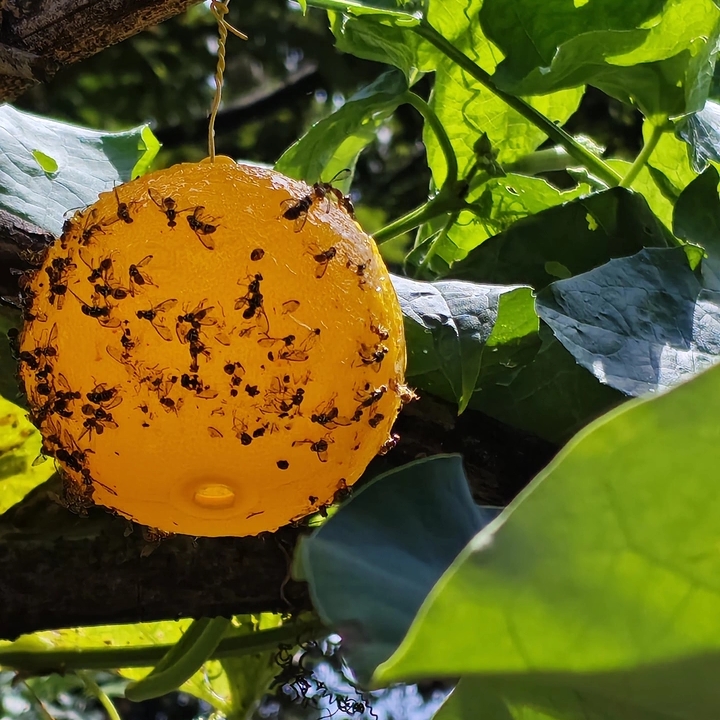
Traditional chemical spraying is becoming less viable due to insect resistance, environmental regulations and the premium prices commanded by pesticide-free fruit. Enter the Orchard Fly Ball: a simple yet scientifically sophisticated physical trap that uses visual stimulus and high-tack adhesives to intercept pests before they can damage the crop. This article explores the engineering behind these weatherproof spheres and why they are essential for modern organic farming.
## Geometric Attraction: Why Spheres?
In the world of insect behavior, visual cues are just as important as olfactory ones. Research into the visual ecology of fruit flies has shown that they are naturally attracted to spherical shapes that mimic the profile of ripening fruit. A red or yellow sphere hanging in a tree canopy is an irresistible visual „super-stimulus.“
By utilizing a 10cm to 12cm diameter sphere, we maximize the surface area available for capture while maintaining a profile that insects perceive as a prime egg-laying site. On our factory floor, we precision-mold these spheres using high-impact polystyrene, ensuring they are light enough to hang from branches but strong enough to withstand heavy winds without cracking.
## Weatherproofing: The Battle Against UV and Rain
An orchard is a brutal environment for any adhesive. Unlike indoor glue boards, orchard fly balls are exposed to direct sunlight, heavy rain and temperature fluctuations from 5°C at night to 40°C during the day.
Standard glues would emulsify in the rain or dry out in the sun. Our fly balls are coated with a „Hydrophobic Visco-Lock“ adhesive. This specialized formulation includes silicone-based polymers that repel water, ensuring the glue remains sticky even during a summer downpour. Furthermore, the adhesive contains a high concentration of UV-blockers. These protect the „tack“ of the glue for up to 90 days of outdoor exposure. Without this weatherproofing, a trap would become a non-functional piece of plastic within a week of deployment.
## Pheromone Integration: Creating a Multi-Sensory Trap
While the visual stimulus of the ball is powerful, the addition of species-specific pheromones creates a synergistic effect. In our manufacturing process, we can incorporate pheromone lures into the center of the sphere or allow for external lure attachments.
The pheromone cloud attracts the insects from a distance and as they approach, the visual cue of the ball takes over, guiding them directly onto the sticky surface. This „Pull and Capture“ strategy is significantly more effective than either method alone. For organic farms, this provides a targeted solution that does not affect beneficial insects like bees, which are not attracted to the specific fruit-fly pheromones or the specific shade of „Ripening Red“ used on the spheres.
## Deployment Strategy: The Grid Pattern Logic
Effective pest control in an orchard is as much about strategy as it is about hardware. We recommend a „Border-to-Interior“ grid pattern. Traps should be placed more densely at the perimeter of the orchard to intercept migrating flies before they enter the core production zone.
The mounting height is critical. Most fruit flies active in orchards fly within the „Fruit Zone“—typically between 1.5 and 2.5 meters high. Hanging the fly balls in the outer third of the tree canopy ensures they are visible to pests and protected from excessive shading by dense foliage.
## Factory Floor Perspective: Durability and Scalability
Producing orchard fly balls at scale requires consistency in the „dip-coating“ process. Each ball must have an even distribution of adhesive to ensure there are no „cold spots“ where an insect could land and escape. We use automated robotic arms to dip the spheres, ensuring a coating thickness of exactly 0.5mm.
We also focus on the „Packaging Integrity.“ Because these balls are pre-coated, they must be shipped in silicone-lined containers to prevent them from sticking to the packaging or each other during transit in hot containers. This attention to detail ensures that when the farmer opens the box, the traps are ready for immediate deployment.
## Economic Impact: ROI for the Organic Farmer
While the initial cost of physical traps may seem higher than a single chemical spray, the long-term Return on Investment (ROI) is substantial. Physical traps provide 24/7 protection for months. They do not require the labor of repeated spraying, they have zero „Pre-Harvest Interval“ (meaning you can harvest while the traps are active) and they allow the farmer to command higher „Organic“ prices.
In case studies from cherry and apple orchards, the use of weatherproof fly balls reduced fruit damage by up to 85% compared to untreated plots, rivaling the efficacy of conventional chemical programs without any of the toxic residues.
## Conclusion: A Sustainable Future for Orchards
The Orchard Fly Ball represents the intersection of biological understanding and industrial engineering. By providing a weatherproof, visual and olfactory interceptor, we are giving organic farmers the tools they need to protect their crops in a sustainable, environmentally friendly manner.
### Physical Trap Installation & Maintenance SOP
1. **Site Inspection**: Identify peak fly activity zones (near light sources or entry points).
2. **Mounting height**: For UV lamps, install 1.5m-2m from floor level.
3. **Glue Board Placement**: Ensure the Visco-Lock side is facing the UV source.
4. **Replacement Cycle**: Swap every 30-60 days or when 70% coverage is reached.
5. **Manufacturer Logistics**: For technical support or bulk custom substrate orders, contact our factory floor.
**Address**: 500m North of Intersection of Shandong Road & Changjiang Road, West Side, Jizhuang Village, Qinghe Subdistrict, Cao County, Heze, Shandong, China.
━━━━━━━━━━━━━━━━━━━━━━━━━━
📞 Contact Our Factory Direct
Shandong Nongzhiwang Agricultural Technology Co., Ltd.
Brand: KEENFLY | 10,000m² Factory | 25+ Machines
CE · EPA · REACH documents on request
WhatsApp: +86 155 5018 1368 / +86 186 6080 2692
WeChat: +86 155 5018 1368 / +86 188 5516 6509
Email: keenfly100@gmail.com
Website: wisetraps.com
Factory Address: 500m North of Intersection of Shandong Road & Changjiang Road, West Side, Jizhuang Village, Qinghe Subdistrict, Cao County, Heze, Shandong, China
MOQ 500 Units | Free Sample Available | OEM/ODM Welcome
━━━━━━━━━━━━━━━━━━━━━━━━━━
Angebots- oder Musteranfrage
KEENFLY (Shandong NongZhiWang Agricultural Technology Co., Ltd.) stellt dieses Produkt im eigenen Werk in Shandong, China her. Großhandel, OEM und Eigenmarke: nennen Sie Maß, Klebstoffmenge und Jahresvolumen, wir antworten mit Spezifikation und Angebot.
Wir antworten innerhalb von 24 Stunden.
WhatsApp: +86 155 5018 1368 / +86 186 6080 2692
WeChat: +86 188 5516 6509 / +86 155 5018 1368
E-Mail: keenfly100@gmail.com
![[DE] Obstgarten Fliegenfalle Ball | Wetterfeste Hänge-Klebefalle](https://wisetraps.com/wp-content/uploads/2026/09/spherical-fly-trap-orchard-ipm-1.jpg "[DE] Obstgarten Fliegenfalle Ball | Wetterfeste Hänge-Klebefalle 3")
