Blue Sticky Traps for Thrips: The Professional Sourcing Guide 2026
Why Blue? The Science of Thrips Attraction
Thrips are among the most destructive pests in commercial horticulture — they transmit tospoviruses, scar fruits and flowers, and develop resistance to chemical insecticides faster than most growers can rotate active ingredients. For greenhouse operators and nursery managers, the question isn’t whether to monitor for thrips; it’s which tools actually work.
Blue sticky traps are purpose-built for thrips control. While yellow traps attract a broad spectrum of pests by reflecting wavelengths between 500–580 nm (yellow-green), blue sticky traps target a narrower band around 450 nm — the specific wavelength that thrips’ photoreceptors are most sensitive to. Research from Wageningen University and the University of California has confirmed that blue traps capture up to 2–3× more western flower thrips (Frankliniella occidentalis) than yellow traps in side-by-side greenhouse trials.
This spectral specificity means you can deploy blue traps as a targeted intervention without drawing in every flying insect in the greenhouse. For IPM programs that rely on beneficial insects (predatory mites, Orius bugs, parasitic wasps), blue traps reduce bycatch of non-target species compared to broad-spectrum yellow boards.
Blue vs. Yellow Sticky Traps: When to Use Each
| Comparison Factor | Blue Sticky Traps (450 nm) | Yellow Sticky Traps (570 nm) |
|---|---|---|
| Primary Target | Thrips (Western flower, onion, chili) | Aphids, whiteflies, fungus gnats, leafminers |
| Secondary Targets | Leafminers (Liriomyza spp.) | Thrips, shore flies, fruit flies |
| Best Environment | Greenhouses, nurseries, high-value ornamentals | General greenhouse, open-field vegetables, orchards |
| Count per m² | 1 trap per 5–10 m² (monitoring); 1 per 2–5 m² (mass trapping) | 1 trap per 5–20 m² |
| Bycatch Risk | Low — preserves beneficial insects | Moderate — may capture parasitic wasps, hoverflies |
| Outdoor Durability | 4–6 weeks (UV-stabilized) | 4–6 weeks (UV-stabilized) |
| Indoor Lifespan | 6–8 weeks | 6–8 weeks |
💡 Pro tip: In mixed-pest environments, deploy a 50/50 yellow-blue grid pattern. Place yellow boards at canopy height for whiteflies and aphids, and blue boards just above the crop row for thrips. This dual-spectrum layout is standard practice in Dutch high-tech greenhouses and has been shown to reduce total pest pressure by 30–40% compared to single-color deployment.
Material & Manufacturing: What Separates Professional Blue Traps
Not all blue sticky traps are created equal. At the manufacturing level, four factors determine whether a trap performs reliably through a full crop cycle or fails after two weeks.
1. Substrate Quality
| Substrate | Thickness | Best Use Case | Advantage |
|---|---|---|---|
| PP (Polypropylene) | 7–15 gsm-equivalent | Short-cycle monitoring, budget programs | Economical, recyclable |
| PET (Polyester) | 15–50 gsm-equivalent | Standard commercial greenhouse use | Heat-resistant, waterproof, dimensional stability |
| PVC | 50–150 gsm-equivalent | Outdoor nurseries, high-wind areas | UV-stabilized, tear-resistant, wind-proof |
| Coated Paper | 80–1200g | Organic certified operations (EU) | Biodegradable, compliant with EU organic regulations |
2. Adhesive Technology
The glue layer is the product. Professional blue traps use hot-melt pressure-sensitive adhesive (PSA) with controlled viscosity and a working temperature range from -10°C to 60°C. Key quality indicators:
- Coating weight: 40–60 g/m² ensures insects are immobilized on first contact without dripping in high-temperature greenhouses (>35°C)
- UV stability: Adhesive must not degrade or lose tack under direct sunlight — outdoor-rated boards require UV-inhibited formulation
- Non-toxic formula: Water-based and solvent-free options available for organic certification and indoor air quality compliance
- Peeling force: 6–8g release liner separation — easy one-handed removal, strong enough to prevent accidental separation during bulk transport
3. Color Consistency & Spectral Calibration
This is where many bargain suppliers fail. A blue trap that drifts toward navy (below 430 nm) or cyan (above 470 nm) loses thrips attraction significantly. Professional manufacturers use spectrophotometer-verified color matching with batch-to-batch tolerance within ±5 nm. At WiseTraps, every production run is tested against a reference standard under D65 daylight simulation before release.
Industry Applications
Greenhouse Vegetable Production
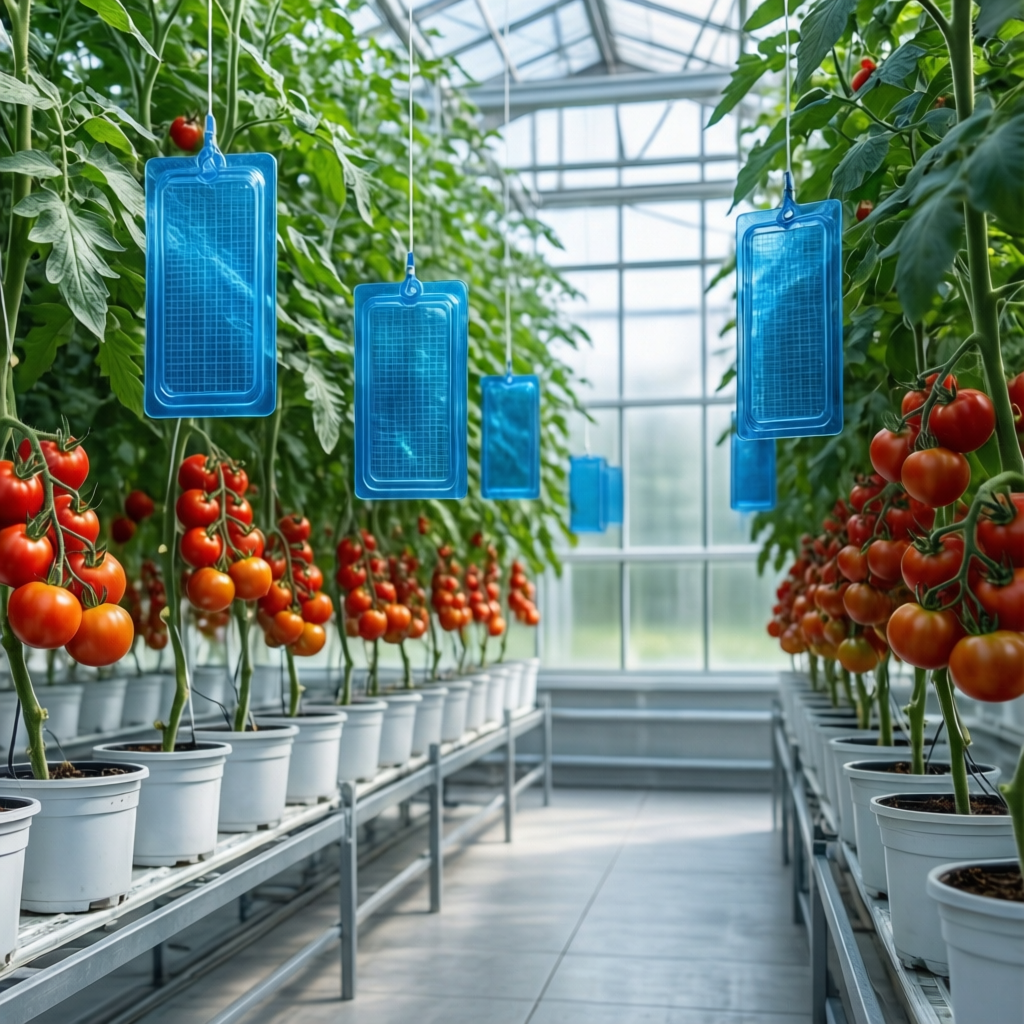
Tomatoes, peppers, cucumbers, and eggplants are prime targets for western flower thrips. In tomato greenhouses, thrips-vectored tomato spotted wilt virus (TSWV) can cause 50–90% yield loss in unprotected crops. Blue sticky traps deployed at a density of 1 board per 20–50 plants, hung 15–30 cm above the crop canopy, provide continuous monitoring that triggers early intervention before viral transmission reaches economic threshold.
Ornamentals & Nursery Stock
Chrysanthemums, roses, gerbera, and poinsettias are thrips magnets. Export-oriented ornamental nurseries in Kenya, Colombia, and Ecuador use blue sticky traps as a phytosanitary requirement — many EU and US import inspection protocols now require documented sticky trap monitoring data as part of the phytosanitary certificate package.
Cannabis Cultivation
The rapid expansion of legal cannabis cultivation has created a new high-value market for thrips control. With pesticide use strictly regulated (and often prohibited entirely in late flowering), physical control tools like blue sticky traps are essential IPM components. Our cannabis-sector clients typically deploy 1 trap per 2 m² in flower rooms and replace every 4 weeks.
B2B Sourcing: 6-Point Quality Checklist
When evaluating blue sticky trap manufacturers for bulk procurement, use this checklist to separate professional suppliers from trading companies:
| # | Evaluation Criterion | What to Ask | Red Flag |
|---|---|---|---|
| 1 | EPA Registration | Is the factory EPA-registered for US market entry? | No EPA establishment number = illegal to import into the US |
| 2 | CE / REACH / RoHS | Can you provide full compliance test reports? | No lab test reports on file = EU customs rejection risk |
| 3 | Spectral Verification | How do you verify the blue wavelength per batch? | No spectrophotometer testing = inconsistent pest attraction |
| 4 | Adhesive Data Sheet | What is the working temperature range and coating weight? | No technical data sheet = adhesive may fail in hot greenhouses |
| 5 | MOQ Flexibility | What is your minimum order quantity for custom sizes? | MOQ above 5,000 for standard products = trading company, not factory |
| 6 | Sample Policy | Do you offer free samples for quality verification? | Charging for standard samples = low confidence in product quality |
Buying Channel Comparison: Factory Direct vs. Retail vs. Trading Company
| Channel | Unit Price (20×25cm Blue, Double-Sided) | MOQ | Lead Time | Quality Control |
|---|---|---|---|---|
| Retail / Amazon | $0.50–$1.20 | 1 pack | 3–5 days | Variable, no batch traceability |
| General Trading Company | $0.15–$0.30 | 5,000 | 15–30 days | Medium, limited factory access |
| Direct Factory (WiseTraps) | $0.05–$0.15 | 500–1,000 | 7–14 days | Full IQC/IPQC/OQC, batch-level traceability |
OEM & Customization: Your Brand, Your Specs
As an EPA-registered, CE-certified manufacturer operating three specialized production facilities totaling 10,000 m², WiseTraps offers full OEM/ODM capabilities for blue sticky traps:
- Custom dimensions: Any size from 10×15 cm to 30×40 cm and beyond — standard or custom die-cut shapes
- Custom shapes: Rectangular, circular, butterfly, flower, and fully custom die-cut designs for brand differentiation
- Custom packaging: Private label with your logo, multi-language instructions, retail-ready box or blister card design
- Custom adhesive: Hot-melt PSA, water-based biodegradable, extra-high-tack for high-temperature environments
- Custom wire ties and stakes: Green PVC-coated wire, bamboo stakes, plastic holders — your choice
- Custom color calibration: Blue spectral tuning to your target species (e.g., 440 nm for onion thrips, 460 nm for chili thrips)
MOQ for OEM orders: 500 units per SKU. Standard production lead time: 7–14 days for repeat orders. Samples are available free of charge for standard products; custom samples ship within 5–7 business days with the setup fee credited against your first production order.

Frequently Asked Questions
Q: How do blue sticky traps compare to chemical sprays for thrips control?
Blue sticky traps are a monitoring and mass-trapping tool, not a replacement for all chemical intervention. In an IPM program, they reduce chemical use by 40–70% by enabling early detection and targeted treatment. They work continuously for 4–8 weeks without reapplication, labor, or re-entry intervals. For severe outbreaks, combine them with spinosad-based sprays or biological controls (Amblyseius cucumeris, Orius insidiosus).
Q: How many blue sticky traps do I need per greenhouse?
For monitoring: 1 trap per 50–100 m². For mass trapping in thrips-heavy environments: 1 trap per 2–5 m². Always place traps within 30 cm of the crop canopy and check twice weekly. Replace when the adhesive surface is >60% covered with insects, dust, or debris.
Q: Can blue traps be used outdoors?
Yes, but only with UV-stabilized PVC or PET substrates. Standard PP boards degrade in 2–3 weeks under direct sunlight. Professional outdoor-grade blue traps maintain integrity for 4–6 weeks. In high-wind areas, use thicker substrates (≥30丝) or secure with double wire hangers.
Q: What certifications do I need for importing blue sticky traps?
United States: EPA registration is mandatory — verify the manufacturer’s EPA establishment number before ordering. European Union: CE marking plus REACH and RoHS compliance documentation. For organic operations, request substrate and adhesive biodegradability certificates. WiseTraps provides full compliance documentation with every shipment.
Q: Do blue sticky traps capture beneficial insects?
They capture significantly fewer beneficial insects than yellow traps. The 450 nm blue wavelength is less attractive to parasitic wasps, hoverflies, and predatory mites than the 570 nm yellow spectrum. This makes blue traps the preferred choice when you’re actively releasing biological control agents. That said, no sticky trap is 100% selective — always monitor bycatch rates and adjust placement accordingly.
Q: What is your minimum order quantity and delivery time?
Standard MOQ is 500–1,000 units depending on size and substrate. Lead time is 7–14 days for repeat orders, 15–20 days for first-time OEM orders. Our daily production capacity exceeds 500,000 units across 25 dedicated coating and die-cutting lines, so we can handle urgent large-volume orders with short turnaround. Contact our sales team for a customized quote based on your specifications.
About WiseTraps — Your Direct Manufacturer
WiseTraps (Shandong NongZhiWang Agricultural Technology Co., Ltd.) is a specialized insect control adhesive products manufacturer backed by a 70-person team operating across three production facilities totaling 10,000 m² in Shandong, China.
| Factory Profile | Details |
|---|---|
| Daily Capacity | 500,000+ units |
| Production Lines | 25 precision coating & die-cutting lines |
| Standard Inventory | 2,000,000+ units across all SKUs |
| Product Lines | 26+ categories, 100+ SKUs |
| Certifications | EPA, CE, REACH, RoHS, MSDS, CNAS |
| Team | 10 sales specialists, 2 after-sales engineers, 2 in-house designers, 1 senior process engineer |
From concept design to finished product to logistics tracking, we handle every step in-house — no outsourcing, no intermediaries, no surprises. Our three-factory model (raw material production in Guangdong, high-speed coating in Caoxian Town, precision die-cutting and packaging in Caoxian City) gives us the flexibility to absorb large orders without compromising quality.
Get in Touch
Ready to discuss your blue sticky trap requirements? Contact our sales team for a customized quote, free standard samples, or OEM consultation:
- WhatsApp: +86 155 5018 1368
- Email: keenfly100@gmail.com
- Website: wisetraps.com
Include your required dimensions, quantity, substrate preference, and target market when requesting a quote. Custom OEM samples ship within 5–7 business days.