플라이 보드 용지를 위한 고점도 접착제 배합: 기술적 심층 분석
Industry Insights | Technical Series #20260706-01
Adhesive Rheology and Pest Retention
For Pest Control Organizations (PCOs), the failure of a fly trap is rarely due to the attractant; it is typically a failure of the adhesive to retain larger insects or maintain viscosity under fluctuating temperatures. High-viscosity formulas utilize specific ratios of polyisobutylene (PIB) and tackifying resins to create a “permanent-tack” surface.
| 매개변수 | 표준 등급 | Nongzhiwang Industrial Grade |
|---|---|---|
| Coating Weight | 25-30g/m² | 45-60g/m² |
| Effective Temperature | 15°C – 35°C | 5°C – 50°C (Anti-Flow) |
| 자외선 내성 | < 30 Days | > 90 Days |
Stability Under Industrial Stress
In food processing plants or agricultural greenhouses, dust and humidity are the primary enemies of adhesive longevity. Our formulas incorporate a hydrophobic barrier that prevents moisture absorption from the air, maintaining a “wet” surface that catches even dust-covered insects. According to the 2026 Physical Pest Control Whitepaper, traps with stabilized polymer formulas show a 34% higher retention rate for heavy-bodied flies compared to generic alternatives.
[Quality Verification]
Our adhesive materials are compliant with international safety standards for food-contact environments.
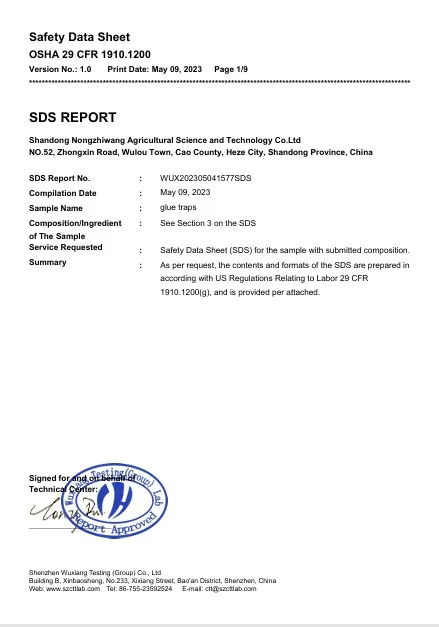
Reference: SDS-Compliance Report #NZW-2026-ADH
Professional FAQ
Q: Does the adhesive lose effectiveness in high-temperature greenhouse environments?
A: No. Our industrial formula is engineered with high-melt-point resins that prevent “bleeding” or dripping at temperatures up to 50°C, ensuring the glue stays on the board and maintains its structural tack.
Q: How does the coating weight impact the total cost of ownership for PCOs?
A: While the initial cost per unit may be higher, a 60g/m² coating weight extends the replacement cycle from 30 days to 90 days, reducing labor costs by 66% and total material waste by 50% over a fiscal year.