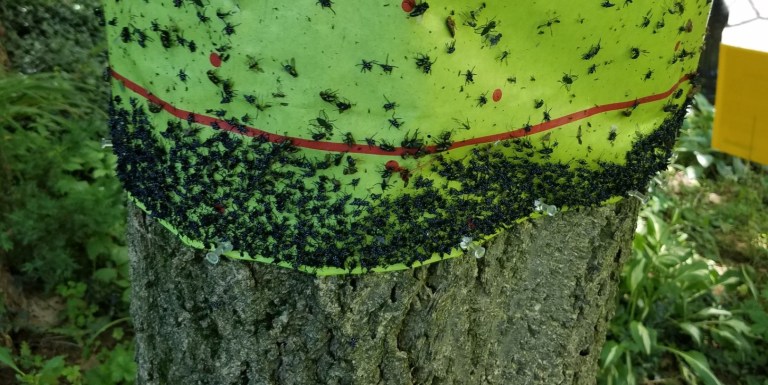
The Science of Visco-Lock Adhesives in High-Dust Stable Environments
In the world of livestock pest control, the effectiveness of a physical trap is entirely dependent on its adhesive. In a laboratory setting, almost any glue will catch a fly. However, the “factory floor” of a modern stable is not a laboratory. It is an environment defined by high levels of airborne dust, fluctuating humidity, and extreme temperature variations. For a fly trap to remain effective for weeks rather than hours, it requires a sophisticated chemical formulation. This article delves into the science behind “Visco-Lock” adhesives—a specialized class of pressure-sensitive adhesives (PSA) engineered specifically for the rigors of high-dust stable environments.
The Dust Challenge: The Enemy of Adhesion
The primary failure mode for sticky traps in stables is “dusting over.” Stables are filled with fine particulate matter from hay, bedding, dried manure, and animal dander. When these particles land on a standard adhesive surface, they form a non-tacky layer on top of the glue. Once this layer forms, a fly can land on the trap and walk across it without being captured. Visco-Lock technology addresses this by manipulating the rheology—the flow behavior—of the adhesive. Unlike standard glues that are relatively static, Visco-Lock adhesives are designed to be “active.” The molecular structure allows the adhesive to flow around and encapsulate small dust particles, drawing them into the body of the glue and leaving a fresh, tacky surface exposed for incoming pests.
Viscoelasticity: The Core Principle
The term “Visco-Lock” is derived from the property of viscoelasticity. A viscoelastic material exhibits both viscous and elastic characteristics. When a fly lands on the trap, the adhesive must behave like a liquid (viscous) to flow around the fly’s legs and wings, maximizing the contact area. Simultaneously, it must behave like a solid (elastic) to resist the fly’s attempts to pull away. This “lock-in” effect is achieved through a precise balance of polymers, tackifiers, and plasticizers. Our formulation uses high-molecular-weight synthetic rubbers that provide the necessary internal strength, while specialized resins provide the immediate “grab” or “green strength” needed to catch a fly in mid-flight.
Thermal Stability: From Frost to Heatwave
Livestock facilities are often open or semi-open structures, meaning the fly traps are exposed to ambient temperature swings. A common problem with cheap adhesives is that they become brittle and lose their tack in the cold, or they become too liquid and begin to drip (run) in the heat. Visco-Lock adhesives are engineered with a broad glass transition temperature (Tg) range. This ensures that the adhesive maintains its optimal viscosity and tackiness from temperatures as low as 5°C to as high as 50°C. We achieve this thermal stability through the addition of specialized antioxidants and UV stabilizers that prevent the polymer chains from breaking down when exposed to heat and sunlight over extended periods.
The Importance of Coating Weight
In the manufacturing of Visco-Lock traps, the coating weight—the amount of glue applied per square meter of substrate—is a critical technical parameter. In high-dust environments, a thin layer of glue is insufficient because it quickly becomes saturated with dust. We utilize a high-volume coating process that applies a thick, uniform layer of adhesive. This thickness provides a “reservoir” of tackiness. Even as the top layer begins to capture dust and flies, the thickness of the adhesive allows for continued migration of the active components to the surface, significantly extending the service life of the trap compared to mass-market alternatives.
Safety and Non-Toxicity
While the adhesive is technically sophisticated, it is designed to be completely non-toxic and safe for use around livestock and personnel. Visco-Lock formulations are free from hazardous air pollutants (HAPs) and do not off-gas harmful volatile organic compounds (VOCs). This is essential in enclosed stables where air quality directly impacts animal health. The adhesive is also food-safe, making it suitable for use in facilities that produce milk or meat. The lack of toxic chemicals also means that there is no risk of the flies developing resistance—a common problem with chemical-based fly control methods.
Integration into IPM Programs
Visco-Lock traps are a cornerstone of Integrated Pest Management (IPM) for modern stables. By providing a reliable, long-lasting physical barrier, these traps reduce the need for frequent chemical spraying. This not only saves money on pesticides but also helps to preserve the efficacy of chemical treatments by reducing the selection pressure for resistance. In high-value stables, such as those housing Thoroughbred horses or prize-winning cattle, the consistent suppression provided by Visco-Lock traps ensures a stress-free environment that is essential for peak animal performance.
Conclusion: Engineering for the Real World
The success of Visco-Lock adhesives is a testament to the importance of application-specific engineering. By understanding the unique challenges of the stable environment—specifically the pervasive dust and temperature fluctuations—we have created an adhesive that provides superior performance where other products fail. For facility managers who demand reliable, low-maintenance, and effective fly control, the science of Visco-Lock is the clear solution.
Standard Operating Procedure (SOP) for Livestock Pest Management
Facility Location: 500m North of Intersection of Shandong Road & Changjiang Road, West Side, Jizhuang Village, Qinghe Subdistrict, Cao County, Heze, Shandong, China
- Monitoring: Weekly inspection of sticky traps and bait bags to assess pest pressure.
- Maintenance: Replace 50m fly ribbon rolls when coverage exceeds 70% or dust accumulation reduces tackiness.
- Sanitation: Clear manure and organic debris within a 5-meter radius of bait stations.
- Documentation: Record pest counts and adhesive performance in the facility logbook.