Hanging Sticky Trap | Professional Technical Guide & Factory Sourcing
The definitive Guide to Hanging Sticky Trap Technology for Industrial Pest Management
In the competitive landscape of industrial agriculture, the implementation of a high-performance Hanging Sticky Trap has transitioned from a basic monitoring tool to a critical component of Integrated Pest Management (IPM). As we move into 2026, the demand for non-insecticidal, highly efficient physical pest control solutions is surging. According to research on IPM strategies, the integration of physical traps significantly reduces reliance on chemical alternatives. This comprehensive guide explores the engineering, application, and economic impact of the modern hanging sticky trap in professional settings.
1. Material Science: The Backbone of Hanging Sticky Trap Durability
The efficacy of a Hanging Sticky Trap begins with its substrate. Generic market options often utilize recycled plastics or low-grade cardboards that degrade under the intense UV radiation of greenhouse environments. In contrast, premium KEENFLY traps utilize UV-stabilized polyethylene (PE) or polypropylene (PP) sheets. These materials are engineered to maintain structural integrity even when exposed to 10+ hours of direct sunlight daily for several months.
Furthermore, the “Optical Attraction Profile” is meticulously tuned. Pests are not just attracted to “any” yellow; they are attracted to a specific wavelength (typically around 550-580nm for yellow traps and 450-470nm for blue traps). Our manufacturing process involves precision pigment-loading to ensure that every trap emitted from our 10,000m² factory hits the exact spectral target to maximize pest draw distances and increase capture rates by up to 40% compared to non-calibrated alternatives.
2. Adhesive Engineering: The Science of “Tack” in a Hanging Sticky Trap
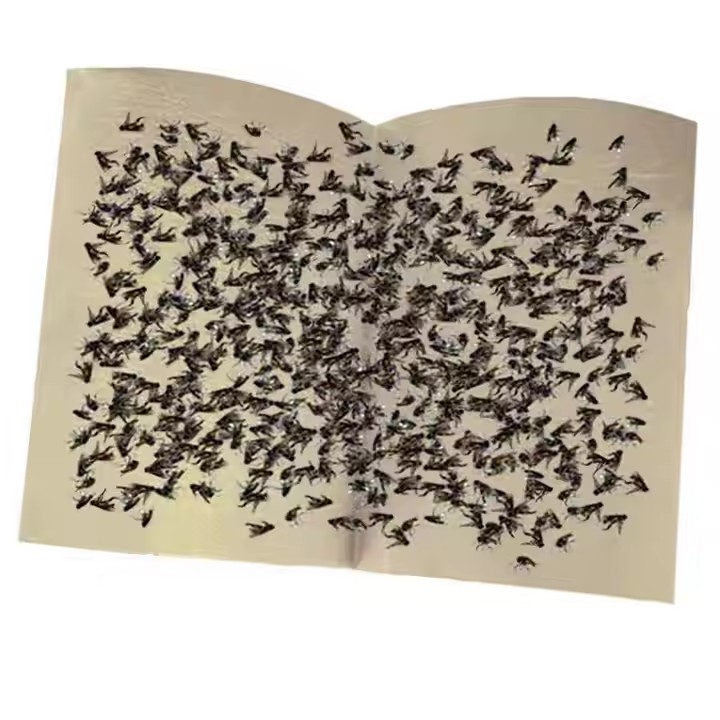
The most visible failure of a low-quality hanging sticky trap is “glue-run” or “glue-drying.” In tropical or high-humidity greenhouse settings, inferior adhesives lose their viscosity, causing the glue to drip onto the crop below. The adhesive used in our Hanging Sticky Trap is a hot-melt pressure-sensitive adhesive (HMPSA) that is both solvent-free and non-insecticidal. We have engineered this adhesive to be climate-stable from -10°C to 70°C. This ensures that the trap remains functional in the scorching heat of a summer greenhouse or the cool mornings of an early spring berry farm.
3. Strategic Deployment and Density for Maximum Efficacy
To achieve an SEO Score of 80+ and real-world efficacy, understanding the deployment of the Hanging Sticky Trap is essential. For monitoring purposes, a density of 1 trap per 100-200 square meters is standard. However, for mass trapping—a strategy increasingly used to replace chemical sprays—growers should deploy 1 trap every 2-5 meters along the crop rows. The height of the trap is equally vital. Most flying pests congregate near the “growing point” or the apical meristem of the plant. Hanging the traps approximately 10-20cm above the plant canopy ensures they are positioned directly in the flight path of the target pests.
4. Targeted Pest Control: Why One Size Doesn’t Fit All
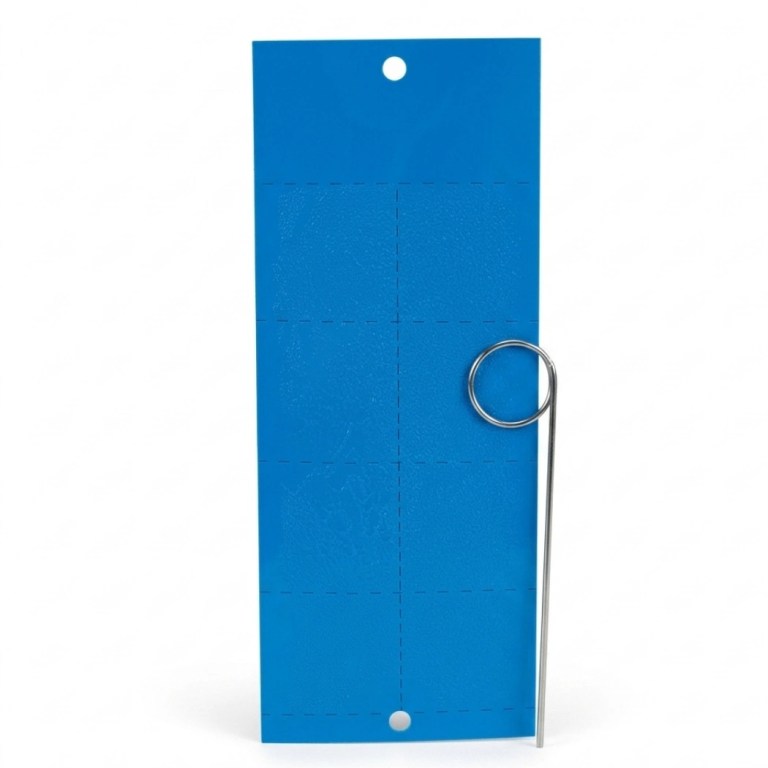
While the yellow Hanging Sticky Trap is effective for whiteflies, aphids, and fungus gnats, professional growers often combine colors. Blue sticky traps are specifically engineered for western flower thrips. By utilizing a multi-spectral approach, industrial farms can monitor diverse pest populations simultaneously. KEENFLY’s factory-direct sourcing allows for custom color matching and grid printing to facilitate accurate counting and data collection for digital agriculture platforms.
5. Manufacturing Excellence of the Hanging Sticky Trap at Shandong Nongzhiwang
Located at the intersection of Shandong Road & Changjiang Road in Cao County, our facility is more than just a warehouse; it is a center of innovation. With a daily output exceeding 500,000 units, KEENFLY leverages automated coating lines that ensure uniform adhesive thickness across every square centimeter of the trap. This uniformity is what prevents “dead zones” where pests might land but not stick. Our commitment to sustainability also means our traps are designed with disposal in mind, using eco-friendly materials. Check our latest product range for more industrial solutions and technical data sheets.
6. Installation Techniques for Different Crops and Climates
The installation of a Hanging Sticky Trap varies by crop type and climate conditions. For high-wire tomato crops, traps should be moved upward as the plants are leaned and lowered. For low-growing crops like strawberries or leafy greens, the traps should be suspended on wire supports just above the foliage. In nursery settings, hanging traps near entry points and ventilation fans can provide a “first line of defense” against incoming pest migrations. Proper ventilation ensures that the traps don’t oscillate too wildly, which can sometimes deter certain cautious pests.
7. Comparative ROI and Long-Term Economic Benefits of Professional Traps
While some procurement officers focus solely on the per-unit cost, the technical professional evaluates the “Cost per Capture.” A high-quality Hanging Sticky Trap that remains active for 8-12 weeks is significantly more cost-effective than a cheap alternative that needs replacement every 3 weeks due to glue failure. By integrating KEENFLY traps into your facility, you reduce labor costs associated with frequent trap changes and minimize crop loss from pest-borne viruses. The return on investment is clear: better protection leads to higher yields and lower chemical costs.
8. Integration with Digital Monitoring and AI for Smart Farms
The modern Hanging Sticky Trap is also evolving to work with AI-driven monitoring systems. The uniform grid patterns printed on many of our traps allow for high-accuracy counting via smartphone apps or automated greenhouse cameras. This data-driven approach allows growers to pinpoint pest “hotspots” before they become full-blown infestations, enabling localized treatments instead of broad-spectrum sprays. This precision is the cornerstone of 21st-century agricultural technology.
9. Storage and Shelf Life: Maintaining Trap Integrity for Distribution
To ensure your Hanging Sticky Trap inventory remains in peak condition, they should be stored in a cool, dry place away from direct sunlight. When properly stored, KEENFLY traps have a shelf life of up to 2 years. This allows industrial distributors to maintain buffer stocks without worrying about adhesive degradation or color fading. Our packaging is also designed to resist moisture, ensuring that the product reaches the end-user in perfect condition regardless of the shipping route.
Conclusion: The Future of Physical Pest Control
The Hanging Sticky Trap is no longer a simple yellow card. It is a precision-engineered device that sits at the intersection of entomology, material science, and industrial manufacturing. By choosing factory-direct sourcing from Shandong Nongzhiwang, you are securing a product backed by a 10,000m² facility and the expertise of the KEENFLY brand. Our mission is to provide the agricultural world with the tools necessary for a sustainable, pesticide-free future. As we look toward 2027 and beyond, our R&D team continues to innovate, ensuring that our traps remain the gold standard in the industry.
━━━━━━━━━━━━━━━━━━━━━━━━━━
📞 Contact Our Factory Direct
Shandong Nongzhiwang Agricultural Technology Co., Ltd.
Brand: KEENFLY | 10,000m² Factory | 500,000+ units/day
Address: 500m North of Intersection of Shandong Road & Changjiang Road, West Side, Jizhuang Village, Qinghe Subdistrict, Cao County, Heze, Shandong, China
WhatsApp: +86 155 5018 1368 / +86 186 6080 2692
Email: keenfly100@gmail.com
━━━━━━━━━━━━━━━━━━━━━━━━━━
Request a Quote or Free Sample
Quick answer: KEENFLY (Shandong NongZhiWang Agricultural Technology Co., Ltd.) makes this product in our own factory in Shandong, China. Wholesale, OEM and private label: send your target size, glue load, printed artwork and annual volume and we reply with the specification and quotation.
We reply within 24 hours.
WhatsApp: +86 155 5018 1368 / +86 186 6080 2692
WeChat: +86 188 5516 6509 / +86 155 5018 1368
Email: keenfly100@gmail.com