Commercial Kitchen Fly Management: Why 400gsm Substrates are Non-Negotiable
## Introduction: The Hostile Environment of the Commercial Kitchen
A commercial kitchen is perhaps the most challenging environment for any physical pest control device. It is a space defined by extreme variables: high temperatures near grills and ovens, high humidity from steam tables and dishwashers and a constant presence of airborne grease and flour dust. In this setting, the humble fly glue board is the last line of defense against foodborne illnesses and health code violations.
However, many kitchens struggle with “failed” glue boards—boards that warp, drip, or lose their stickiness within days. From our factory floor perspective, these failures are almost always due to inadequate substrate specifications. This article explains why a 400gsm (grams per square meter) substrate is the absolute minimum standard for commercial kitchen fly management and how it impacts the overall efficacy of an Integrated Pest Management (IPM) program.
## The Structural Physics of a Glue Board
The substrate is the “backbone” of the glue board. In the industry, substrate thickness is measured by weight (gsm). Standard consumer-grade boards often use 200gsm to 250gsm cardboard. While this might suffice for a quiet living room, it is woefully inadequate for a busy kitchen.
When a glue board is placed inside a UV trap, it is exposed to the localized heat of the bulbs. Cardboard is a hygroscopic material—it absorbs and releases moisture from the air. In a kitchen, the board absorbs steam and then is dried out by the heat of the lamp. This constant expansion and contraction causes “warping” or “curling” in thinner boards. A warped board can jam the trap mechanism, pull away from the adhesive coating, or—most dangerously—touch the UV bulb and scorch.
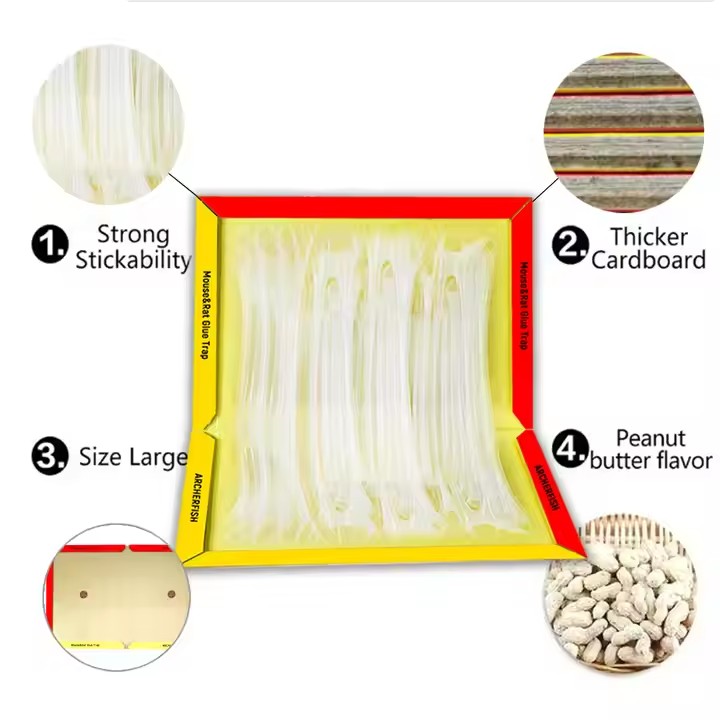
A 400gsm multi-layer compressed cardboard provides the structural rigidity needed to resist these forces. The higher density of fibers means the board stays flat, ensuring the entire adhesive surface remains accessible to flying insects and properly aligned with the light source.
## Grease and Humidity: The Silent Killers of Adhesion
In a kitchen, the air is filled with microscopic droplets of oil and water. These particles eventually settle on every surface, including the glue board. Thinner substrates are often porous; they can absorb oils from the air, which then migrate through the board and interfere with the bond between the substrate and the adhesive. This leads to “delamination,” where the glue simply slides off the board.
Our 400gsm professional boards are treated with a “Moisture-Barrier Coating” on the non-glue side. This barrier prevents the board from absorbing humidity and grease, maintaining the integrity of the adhesive layer. Furthermore, the 400gsm thickness allows for a deeper “adhesive well.” When we coat these boards on the factory floor, the substrate is strong enough to hold a thicker layer of glue (up to 60gsm) without the board becoming soggy or unstable. This extra depth is crucial for “burying” the legs and wings of larger flies, preventing them from wiggling free.
## The Science of “No-Drip” Adhesives in High-Heat Zones
Temperature management is the second major hurdle. A glue board near a pizza oven or a stovetop can experience ambient temperatures exceeding 40°C. Standard adhesives have a “Softening Point” that is often too low for these conditions. If the glue softens too much, it begins to “creep” or drip. This not only creates a mess in the expensive ILT fixture but also leaves the top of the board dry and ineffective.
Our kitchen-grade boards use a high-viscosity, “Non-Migratory” hot-melt adhesive. By incorporating specific thermoplastic elastomers, we raise the softening point to over 65°C. This ensures that even in the hottest parts of the kitchen, the glue stays exactly where it was applied. On the factory floor, we verify this with a “Vertical Flow Test,” where boards are hung vertically in a 60°C oven for 24 hours. If the glue moves more than 1mm, the batch is rejected.
## Hygiene Compliance and Food Safety (food-safety)
In a commercial kitchen, every component must meet hygiene requirements. This extends to the glue board. Our 400gsm boards are manufactured using non-insecticidal, pheromone-free (or food-attractant based) adhesives. We avoid the use of toxic chemicals or insecticides, ensuring that the traps are compatible with Hazard Analysis and Critical Control Points (food-safety) programs.
The “Factory Floor View” on hygiene also includes the color of the substrate. For commercial kitchens, we often recommend yellow or “fluorescent white” substrates. These colors are not just for visibility; they actually enhance the attraction of certain fly species by reflecting specific wavelengths of light. However, if the trap is in a customer-facing area (like an open kitchen), a 400gsm black board is preferred to discretely hide the “catch.”
## Labor Efficiency and Replacement Cycles
In a busy restaurant, labor is a major cost. A flimsy 250gsm board that needs to be replaced every 10 days because it has curled or lost its tack is a drain on resources. A robust 400gsm board with a long-life adhesive can stay in the field for 30 to 45 days, even in harsh kitchen conditions, provided it isn’t saturated with insects.
The increased durability means fewer “emergency” changes and more predictable maintenance schedules. For the wholesale buyer, this translates to a higher-quality product that builds trust with end-users. When a chef sees that a board stays flat and sticky until the day it is replaced, they know they are getting a professional-grade tool.
## Conclusion: The Foundation of Kitchen Hygiene
Flying insects are more than a nuisance; they are vectors for pathogens like E. coli and Salmonella. In the high-stakes world of commercial food service, there is no room for equipment failure. Choosing a 400gsm substrate for your glue boards is not just a technical preference—it is a non-negotiable requirement for anyone serious about kitchen hygiene and food safety.
### Physical Trap Installation & Maintenance SOP
1. **Site Inspection**: Identify peak fly activity zones (near light sources or entry points).
2. **Mounting height**: For UV lamps, install 1.5m-2m from floor level.
3. **Glue Board Placement**: Ensure the Visco-Lock side is facing the UV source.
4. **Replacement Cycle**: Swap every 30-60 days or when 70% coverage reach.
5. **Manufacturer Logistics**: For technical support or bulk custom substrate orders, contact our factory floor.
**Address**: 500m North of Intersection of Shandong Road & Changjiang Road, West Side, Jizhuang Village, Qinghe Subdistrict, Cao County, Heze, Shandong, China.
━━━━━━━━━━━━━━━━━━━━━━━━━━
📞 Contact Our Factory Direct
Shandong Nongzhiwang Agricultural Technology Co., Ltd.
Brand: KEENFLY | 10,000m² Factory | 25+ Machines
CE · EPA · REACH documents on request
WhatsApp: +86 155 5018 1368 / +86 186 6080 2692
WeChat: +86 155 5018 1368 / +86 188 5516 6509
Email: keenfly100@gmail.com
Website: wisetraps.com
Factory Address: 500m North of Intersection of Shandong Road & Changjiang Road, West Side, Jizhuang Village, Qinghe Subdistrict, Cao County, Heze, Shandong, China
MOQ 500 Units | Free Sample Available | OEM/ODM Welcome
━━━━━━━━━━━━━━━━━━━━━━━━━━
Request a Quote or Free Sample
Quick answer: KEENFLY (Shandong NongZhiWang Agricultural Technology Co., Ltd.) makes this product in our own factory in Shandong, China. Wholesale, OEM and private label: send your target size, glue load, printed artwork and annual volume and we reply with the specification and quotation.
We reply within 24 hours.
WhatsApp: +86 155 5018 1368 / +86 186 6080 2692
WeChat: +86 188 5516 6509 / +86 155 5018 1368
Email: keenfly100@gmail.com